From Rikers Island to free pitches: Mamdani on NYC's World Cup
From discounted tickets and free fan festivals, to 24-hour pitches and a visit to Rikers Island, New York City Mayor Zohran Mamdani tells GOAL how his administration sought to make the World Cup accessible - and what he hopes it will leave behind.
Posted Wednesday, July 22, 2026 by goal
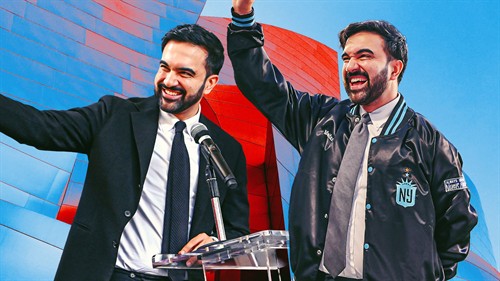
Zohran GFX
From discounted tickets and free fan festivals, to 24-hour pitches and a visit to Rikers Island, New York City Mayor Zohran Mamdani tells GOAL how his administration sought to make the World Cup accessible - and what he hopes it will leave behind.
NEW YORK -- Of all the conversations Zohran Mamdani had at Rikers Island last week, one stayed with him. The New York City mayor watched the World Cup semifinal between England and Argentina alongside some of the roughly 7,000 people detained at the jail complex. During those 90 minutes, he met one man preparing to leave that day.
“I actually met a man there for whom it was his last day on Rikers,” Mamdani told GOAL at Gracie Mansion. “He was going home that day, and he was so excited to see his daughter, who was about to pick him up.”
The exchange had little to do with tactics or the scoreline. But for Mamdani, the match created space for a conversation between two New Yorkers whose paths otherwise might never have crossed. That sense of connection, he said, shaped how he wanted the city to experience the World Cup.
That conversation was a stark reminder, Mamdani reflected, that soccer, more than anything, is a unifying force. There he was, the Mayor of New York, bonding with a man he might have never met, thanks to the thing that was on the television. And that has been the central aim of Mamdani’s World Cup experience.
World Cups are difficult things to navigate. And harnessing the World Cup in New York City presented a particular challenge. More than 8 million people live across the five boroughs, many with ties to the nations represented, yet all eight local matches - including the final that brought the tournament to a close - were staged across the Hudson River at New York/New Jersey Stadium. Mamdani’s administration set out to bring the tournament closer to those communities and make it more accessible. After 39 days and dozens of citywide initiatives, the 34-year-old mayor believes it succeeded.
“There's always more to do. I am also proud of what we've been able to do over the last month and some change. In the lead-up to the World Cup, there are so many questions of who is this for, where do New Yorkers fit into this vision of the tournament of the city, and one of our focuses was how do we make this affordable,” he said.
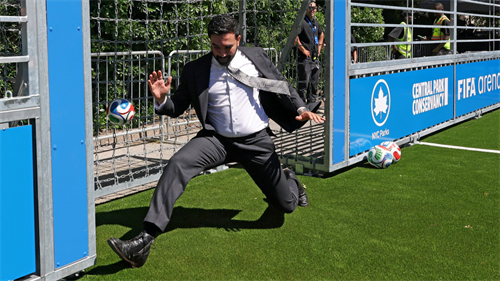
Zohran Mamdani
Making soccer more affordable
That was the central issue with the World Cup. With ticket prices soaring into the thousands and public transportation prices being hiked, Mamdani inherited a World Cup that was inaccessible for a majority of those who wanted to watch it. He also faced bureaucratic issues. New York and New Jersey shared custody of MetLife Stadium. That meant dealing with the state of New Jersey, the area’s host committee, as well as FIFA itself.
Mamdani, an avowed soccer fan who attended the 2010 World Cup in South Africa as an 18-year-old, took on those challenges in full. The administration’s room to maneuver was limited. The matches were staged in New Jersey, while many of the biggest decisions belonged to FIFA and the local host committee. Mamdani’s administration instead focused on the areas it could influence directly, including discounted tickets, free viewing events and places for New Yorkers to play.
“We were proud to be the first and only host in the city to get an allocation of discounted tickets - 1,000 tickets at $50 apiece. When I came into office, the fan fests were supposed to be ticketed at a price. We made them free every single fan fest across New York City,” he said.
There was more, too: free late-night soccer pitches, a permanent field in Central Park, $26 deals on food and drink at select bars and restaurants around the city. NWSL teams were brought into the fold, too, with $15 tickets offered for the fixture between Gotham and Washington Spirit at Citi Field (the stadium sold out, with 42,175 fans in attendance).
Those initiatives could not resolve every complaint surrounding the tournament. Match tickets remained beyond the reach of many New Yorkers, traveling to the stadium was expensive, and the city was part of a complex puzzle that included FIFA, the host committee and New Jersey. The 1,000 discounted tickets also represented only a small fraction of the seats available across eight matches. Yet it was still more than anyone else managed. And Mamdani argued that the city had made the tournament more accessible beyond the stadium.
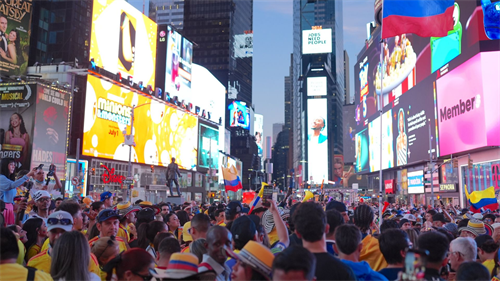
Colombia fans Times Square
'No matter who's playing, it's a home game'
Getting this kind of thing right is important in all of FIFA’s 16 cities - never mind the dozens more that hosted training camps. But it tends to feel a bit more important in New York - largely due to massive immigrant populations, Mamdani explained.
“You cannot describe the soccer or the football culture of New York City without describing immigrant culture in New York City, and it's part of why it feels like no matter who's playing, it's a home game,” he said.
And that’s why dozens of enclaves across the five boroughs were strategically targeted for programming. Fifty car-free streets near schools were converted into football pitches in the run-up to the tournament. Mamdani’s office put on events in immigrant communities around the city. Gracie Mansion, the mayor’s residence, was home to pickup games throughout the tournament. Mario Balotelli turned up for one of them. The second-to-last iteration highlighted immigrant diasporas that had seen their sides qualify for the tournament for the first time.
“We've seen both the communities that we have associated with the World Cup for years - the Brazilian community, the Colombian community. And some for whom it was the first time: Uzbekistan, Cape Verde. You saw Haiti for the first time in decades, and what it meant to parts of the city,” Mamdani said.
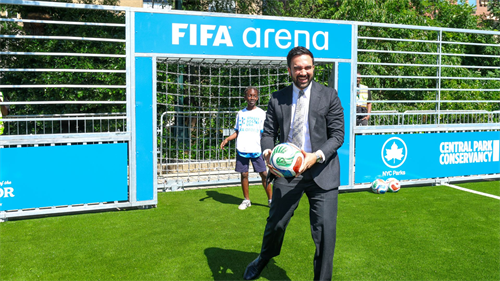
Zohran Mamdani
'Something that can live on beyond the game'
On June 8, Mamdani nerded out. He stood on a newly unveiled five-a-side pitch in Central Park, 1995 Ballon d’Or winner George Weah beside him. His remarks included a homage to the former Monaco, PSG and Milan forward, someone whom Mamdani admitted he idolized.
“When I was a child growing up in East Africa, there were towering figures. And then there was George Weah. The first African player to ever win the Ballon d'Or. If you had told seven-year-old me that I would one day go into the same line of work as this man, I would be extremely disappointed to understand that you meant politics,” he said to a pool of reporters.
But the field on which he stood was more important than his childhood reflections. The question of legacy around any World Cup is a tricky one to confront. These tournaments exist not only in the six weeks that they are played but for the months, years, and decades after.
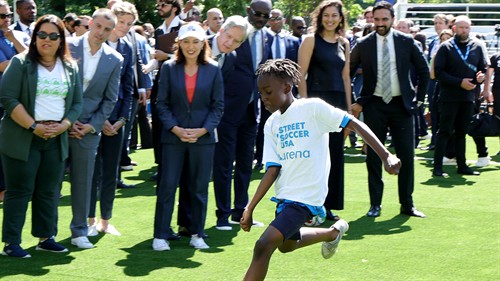
Figuring out how it can last longer is a real challenge. For Mamdani, the route was to allow people to play, for free. That meant one pitch in each borough open 24 hours per day - as well as a field in Central Park that ran for six weeks.
“We wanted to make this something that could live on beyond just the game. So we made a number of fields, one in each borough, 24/7 fields, and that to me is also what this tournament has to be about. It has to be beyond just the pitch and the match. But what does it leave New Yorkers with at the end of the day?” Mamdani said.
FIFA Arena
Thinking about the future of soccer
Mamdani, ever the soccer fan, is aware that such initiatives are not only good for morale, but might also be a factor for the game, too. Soccer is too expensive in this country, and inaccessible for most. Too often, pitches are inaccessible, overpriced, or simply not good enough. Making soccer free - or close to it - can help the country long term.
Who knows, there might even be a USMNT legend that graduates from one of these things.
“I also hope that in the decades from now we look back and we can find a U.S. Men's National Team player who found their way through the 24/7 field, who found their way, you know, on one of the subway trains that we wrapped in the colors of the nations that were playing here,” he said.
That is part of an effort for every tournament. And the more eyes, legs and more accessibility, the better this game might just be. The data is there to support it.
“Every World Cup, everyone will always say ‘We did it!’ But I think if you're just looking at the statistics, almost as many Americans watched the U.S. men's national team play as they did the Knicks. That is an incredible figure when you're talking about one game, one match, and highlighting the interest,” Mamdani added.
Mamdani
'You're all watching the same game'
This World Cup ended up being quite cool, too. The NYC-inspired jerseys designed by a Brooklyn art studio, Mazzi, sold out rapidly. Activations from major brands, featuring some of the biggest names in soccer, culture and art, popped up around the city. The world looked long and hard at New York. The eye test suggested things were pretty good.
But perhaps the lasting image is that afternoon on Rikers. The 400-acre complex is accessible by a bridge from Queens, but otherwise completely isolated from the city that runs it. But for one day, it was so, so connected to the rest of the City. Everyone here is a New Yorker. The World Cup proved a reminder of that.
“When you're in a place like Rikers Island, it feels like you're living in a different world. You can look out through the bars and see a city that it feels like often isn't looking back at you. And we want to make clear that this is, in fact, one city. What's so special about [the World Cup] is that no matter where you are in your life, you're all watching the same game,” Mamdani said.

- Daily
- Weekly
- Monthly
Photos
More»

Arsenal's World Cup minutes give Arteta injury headache
Wednesday July 22 2026
Your Say