What it's like to win a World Cup from those who have done it
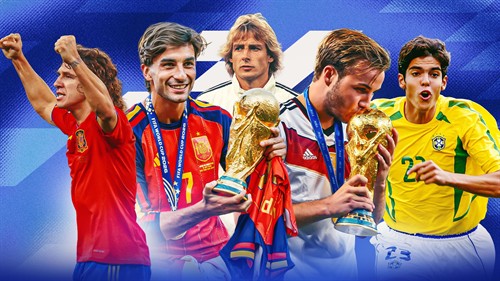
World Cup winners Jurgen Klinsmann, Kaka, Mario Gotze and Carles Puyol tell GOAL about the pressure, relief and lasting impact of lifting the trophy.
Posted Tuesday, July 21, 2026 by goal
WC Winners GFX
World Cup winners Jurgen Klinsmann, Kaka, Mario Gotze and Carles Puyol tell GOAL about the pressure, relief and lasting impact of lifting the trophy.
The moment Ferran Torres roofed his shot into the net to win the World Cup, he joined one of soccer’s most exclusive groups. Only three other living men - Geoff Hurst, Andres Iniesta and Mario Gotze - have scored an extra-time winner in a World Cup final. Only they know the euphoria that comes with delivering the game’s biggest trophy on its biggest stage.
“You also need to speak to [Andres] Iniesta,” Gotze told GOAL with a laugh a month before Torres added his name to that list.
Even now, 12 years later, there isn't a day that goes by when Gotze doesn't get asked about his own moment at the 2014 World Cup. It came when he was 22 years old. On that night in Brazil, Gotze became legendary. On that night, he scored the biggest goal of his life. On that night, he won a World Cup for his country against Argentina, the same opponent Torres just brought down with a goal seven minutes earlier than Gotze's 113th-minute finish.
"Looking back," he says, "I mean, it's 12 years ago already. It blurs over time a bit."
In total, 497 men have gotten their hands on that big gold trophy. A new group of 26 Spanish stars lifted it on Sunday, earning their own invite to the historical club. Thousands have tried and fallen short, while millions of kids began their journey with the ball by imagining themselves with a World Cup trophy raised above their heads. The reality is that so few people know what that feels like, and those who do struggle to describe it.
That's because the World Cup is more than a mere trophy. It's a symbol of both achievement and hope. It's a unifier of countries, a statement of success and a moment in history. It's so much more than a soccer trophy; it's a moment that changes the trajectory of lives, both for those on the field and those watching at home. Everyone remembers where they were when they see their team win a World Cup, and every player lucky enough to lift it remembers exactly what it felt like the moment that the dream became real.
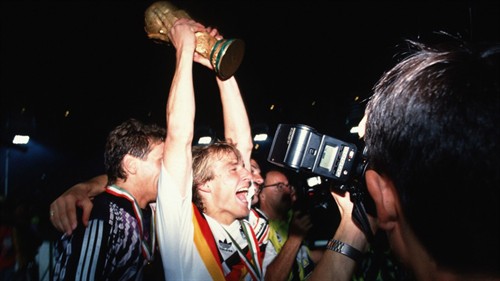
"When you actually, with your team, win the World Cup, you realize that it's something that will be with you for the rest of your life," Jurgen Klinsmann, a World Cup winner in 1990 with West Germany, tells GOAL. "When you grow up as a kid, you always kick the ball around, and you pretend to win a World Cup one day, but you can never imagine what it's like when you one day have the chance to actually win a World Cup yourself."
So what does that moment feel like? This is a look at how life changes, in the words of the men who have won the world's biggest trophy.
WC2002-GER-BRA-CUP AND KISS
'Something you cannot train'
For Brazil, winning a World Cup is less a dream than an expectation. The Selecao’s history is filled with golden generations, and each new wave of talent immediately feels the weight of those that came before.
That's how Kaka felt when he burst onto the scene in 2002 anyway. Just 20 years old, he was Brazil's youngest player that summer in South Korea and Japan. And that summer, the future Ballon d'Or winner was merely along for the ride as he played just 18 minutes of Brazil's World Cup run.
“It was Ronaldinho, Ronaldo Fenomeno, and Rivaldo," he tells GOAL. "I watched them every day. I wanted to see them training, playing and behaving. They were my teachers."
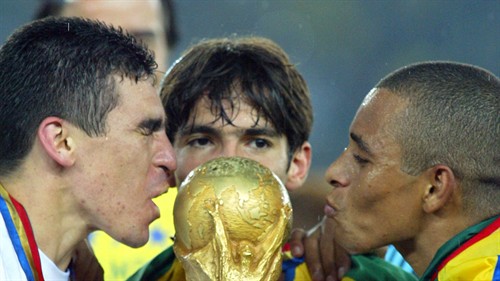
Those teachers, of course, led Brazil to glory. They famously beat Germany in the final to add the fifth star to their jersey. Kaka remembers the feeling. He describes it in one word.
"Incredible."
He also remembers the road there. The longer a World Cup goes on, the more the pressure turns up. That pressure, at a point, becomes overwhelming, even for 20-year-old rising stars that aren't playing.
“It’s strange because it's something that you cannot train," Kaka says. "I cannot train to play in a World Cup. I can prepare myself in the best way: emotionally, physically, technically, and those things, but I cannot train myself to be in a full stadium, playing against Argentina, France, or whatever. You never know how you’re going to handle the situation.”
Gotze remembers the pressure, too. He felt it leading up to Germany's 2014 final against Argentina. He remembers how it felt when he was introduced as a substitute in the 88th minute of that final. As he was tossed into the game with both teams chasing a winner, manager Joachim Low looked at him and gave him a key instruction: "Show the world you are better than Messi and can decide the World Cup."
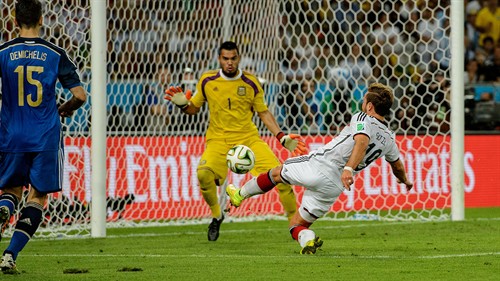
Gotze, of course, did that by scoring a 113th-minute winner that, to this day, is one of the most famous goals in the sport's history. When he scored it, he didn't necessarily feel joy; he felt pressure. In the end, he felt relief.
"You cannot prepare for these moments," he tells GOAL. "A lot of things happen out of instinct, especially these kinds of things. In the end, it matters if the defender is there or if the goalkeeper comes out, so there are so many factors that play into a moment. You do everything out of instinct, and then, of course, you have that moment. When you score it, to be fair, you don't think that much. The time flashes in the stadium, everybody grabs you, the noise - you can't really process it.
"The final whistle? I think that was more the relief. The joy was in scoring the goal, of course, but still you have to go 10 more minutes then. Then there's that relief at the final whistle."
Germany v Argentina: 2014 FIFA World Cup Brazil Final
Being the man of the moment
Gotze's famous moment has been replayed countless times: the run from Andre Schurrle, the cross into the box, the touch off his chest, the finish past Sergio Romero. It was the sequence of a lifetime. It was the moment every player dreams of.
Over the last 12 years, Gotze has, of course, thought about it often. And the more he's thought about it, the more he's come to terms with the fact that, in that one brief moment, the soccer gods smiled on him. In that one moment, years of work aligned with a lifetime of luck, allowing him to capitalize.
That, of course, makes you think about the other side of it and, when you do, you arrive at one takeaway: winning a World Cup comes with a degree of randomness and a whole lot of making the most of a moment when and if it arrives.
"I was subbed on," he says. "If, in the end, Messi scores a goal in the 90th minute, it's 1-0 Argentina, you go home, and it's a totally different story. To understand that, what could have happened? For this story, we talk about that goal, the moment, but if that didn't happen back then, we wouldn't sit here and have this interview, you know? I think you have to understand that it could have gone both ways. I could go home very sad, second place, played a minute in the finals, that's it. Now, we're sitting here, 12 years later, having an interview.
"I didn't play the semifinals. I didn't play the quarterfinals. We could have gone out. And then I had a chance in the final, and, in the end, I played 30 minutes in the final, I scored, and we are still talking about that goal."
FBL-WC2010-MATCH64-NED-ESP-TROPHY
Understanding the achievement
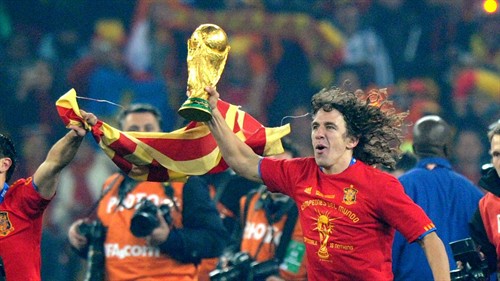
Four years before Gotze and Germany's triumph, Spain had one of their own. What made that one unique was that it was Spain's first. They are the only first-time winner this century, the most recent country to experience the euphoria of winning a World Cup for the very first time.
Theirs came in similar fashion. Facing the Netherlands in the 2010 final, La Roja won on a late goal of their own. It came from Andrés Iniesta, and it was, of course, more than a goal. It was a moment of national history, one that Spain had felt like it had earned.
They earned it, in particular, in the years leading up to that tournament. They won the Euros in 2008, starting the makings of a tiki-taka dynasty that also won a European title in 2012. Even so, the summer of 2010 stood alone as Spanish soccer’s crowning achievement until Sunday, when La Roja defeated Argentina to lift the trophy for a second time.
"A World Cup is a dream come true," Carles Puyol, a defender on that 2010 Spain team, tells GOAL. "And on top of that, how it was won, after winning a European Championship. I think that's where the history of Spanish football changed, and being able to be world champions is the ultimate achievement at the national team level."
Gotze remembers the moment when it really hit him that he was a world champion. It didn't happen when his famous late winner hit the back of the net. It wasn't when he lifted the trophy. It wasn't even in the locker room.
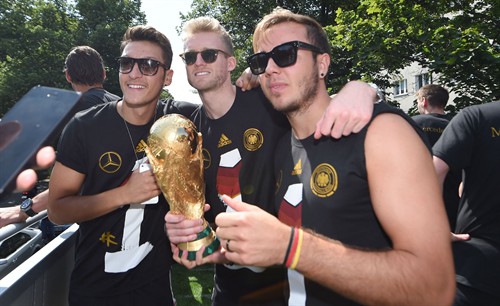
No, Gotze's real World Cup moment came days later when he and his teammates left Brazil and returned to Berlin. Only then did they realize what it meant. Only then did they realize what they had done for their country.
"The depth of it, what happened in that moment, and even scoring the goal, I think that takes days," he says. "You're in the moment. You celebrate with family and friends, then we travel back to Berlin. So many things happen within the next two, three, four days. Then you're on vacation, and you have the time to like, 'Okay, what just happened?' Even then it takes time, weeks to months, to understand what it really meant for the people, but also for us and for me."
imago-sport-1008233154.jpg
The outside politics
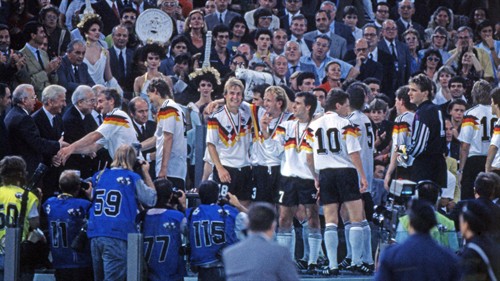
When Klinsmann and West Germany won in 1990, though, their return home from Italy was somewhat surreal.
It came as Germany moved rapidly toward reunification. Just months after the Berlin Wall fell, the country’s new heroes returned to a nation beginning to come together emotionally, even though official reunification would not arrive until October. Klinsmann and his teammates had felt that shift throughout the tournament.
"We were a team in 1990 that was the picture of a new Germany," he says.
Klinsmann recalled East German supporters traveling to Italy by the thousands, making it clear to the players that their run represented something far bigger than soccer.
"We're at the games, but you understood during the tournament that this is far bigger than you are," he says. "This is something really difficult to comprehend, because it's huge."
He added that the moment carried particular personal significance. His father had left East Germany after World War II before meeting his mother and settling in West Germany, while much of the family remained on the other side of the divide. It was an experience shared by countless German families.
“Suddenly, seven months prior to the World Cup, Germany is back together,” he says. “For us, it was emotionally already very, very extreme to go through that situation.”
The political backdrop can also become impossible to ignore. That was evident when Argentina faced England in a World Cup semifinal accompanied by renewed discussion of the Falkland Islands dispute, adding another layer to an already enormous occasion.
For Klinsmann and his teammates, the significance came from representing West Germany at a moment of profound national change. When the final ended and they had won, they understood that their achievement resonated far beyond the field. It is estimated that between 500,000 and one million fans gathered in Frankfurt to welcome the team home. Official reunification followed in October, but the World Cup triumph had already become a powerful symbol of a country coming back together.
"We had that moment with a national team that was really full of talent, with an incredible leader, Lothar Matthaus, with an incredible coach, Franz Beckenbauer," Klinsmann says. "And there you are, part of that project. We lived through that time with so many different aspects of looking at it. We had different ways of looking at it and feeling it differently, so it made it just unforgettable.
"For you to actually then end up even winning this tournament? It was about putting Germany back on track with the world, but also with a smile on its face."
FBL-WC-2014-GER-FANS
'Not the standard'
In total, Kaka went to three World Cups. He can admit now that, after winning the first one, he was a little bit naive. It would always be like 2002, he thought. He couldn't have been more wrong.
In both 2006 and 2010, Brazil crashed out in the quarterfinals. Those experiences have only strengthened the former midfielder's connection to 2002. It was only after experiencing heartbreak that he realized what he and his teammates achieved in 2002.
“Yes, the expectation was to win again in 2006 and 2010," he says, "but what was really important for me was to understand how hard it is to be in a World Cup, to win a World Cup. I went in 2002, 20 years old. In my head, it's really easy to just go and win the World Cup.
“Every year I realized how hard it is to play a World Cup and to win a World Cup, and how big it is to have a World Cup in my achievements."
Individually, Kaka, of course, reached incredible heights, winning Serie A, La Liga, the Champions League and a Ballon d'Or in the coming years. For Gotze, though, his World Cup moment, which came at age 22, was his peak. He went on to make 66 total appearances for Germany, although only 25 of them came after 2014. Gotze's best moment came so early in his career but, realistically, what moment could have been better?
"I had that moment, I had that experience, but, of course, afterwards, you have to find your perspective," he says, "and I think that that took time. I was very young, 22 back then, just played with Bayern and won a lot of trophies, won the World Cup. That's the standard you have after five years of playing professional football. That's the standard, and to keep that for the next 10-15 years, I think, is almost impossible.
Still, that's a hard thing for a young player to come to terms with: experiencing the best of it so early. It's something Gotze had to work through.
"That's what I needed to learn over time, but still, when I now look back, it helped me a lot," he says. "I had a lot of learnings out of the pinnacle of my career in Brazil, but also to understand that that's not the standard. You cannot score every four years in a World Cup final."
Jurgen Klinsmann World Cup 1990
'Something that will never leave you'
The truth is, though, that you don't need to win a World Cup every four years; it only takes one to change your life. The moment you lift that trophy, life changes dramatically. Your achievement follows you, and it can never be taken away.
"You travel the world and you run into people that say, 'I was there when you won the World Cup'," Klinsmann says. "They say, 'I did this when you won the World Cup in 90' and it's still like, 'Holy moly, what is this?' When I went to Asia or Africa or South America, it's always in the mind of football fans. They remember where they were, what they did at that time."
The more the years go on, the harder it is to capture the memory. After a World Cup, teams go their separate ways. Players go back to their clubs and, the very next international break, the roster changes. The more time goes on, the harder it is for everyone to get together. Life makes it hard, particularly life at the pinnacle of this sport.
It's the little interactions, then. That's what Gotze says, at least. It's the quick reunions that lead to quick reflections and extended laughs.
"I think that's what sticks with you the most in the end," he says. "In the end, it's about relationships, you know? It's about making memories. When I look back now, it was more the camp, the players we had there, the dynamic, the chemistry, and this helped a lot.
"Everybody's life is going their way. Some are still playing, some stop playing, some are moving to other countries, etc., but it's always good. This moment will connect you. It's very difficult to get everybody together, that's for sure, but, in the end, it's more the connection you have to that tournament, that moment, those relationships and the memories you made with them."
Ultimately, that's what you have in the end: memories and relationships. The trophy is eventually won by the next team. Every four years, a new group of players gets to experience their own feeling in their own circumstances. The sport, as it turns out, moves on.
The people don't, though. Winning a World Cup is something that redefines your life, and it redefines it in a way that never really goes away.
"You become conscious that it's something that will never leave you," Klinsmann says. "Afterwards, after a couple of days of partying, you then have vacation and go back to business with your club team, but you understand the dynamic. You did something with your team that is there forever."
Tom Hindle added reporting to this story.
-
World Cup

- Daily
- Weekly
- Monthly
Photos
More»

Lamine Yamal dances wildly and Spain hero trolls Donald Trump
Tuesday July 21 2026
Your Say