'Only going to get so much bigger' - Why Atlanta was WC's best host
After playing host to eight games and drawing in 500,000 fans, it is clear why Atlanta pushed so hard for both MLS teams and an opportunity to hold World Cup fixtures.
Posted Friday, July 17, 2026 by goal
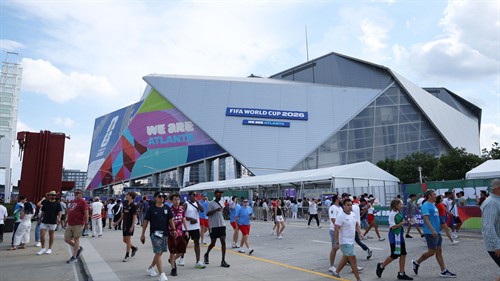
Congo DR v Uzbekistan: Group K - FIFA World Cup 2026
Atlanta did not need the World Cup to manufacture a soccer culture. Eight matches and more than half a million fan-festival visitors only confirmed what the city had spent nearly 60 years building.
ATLANTA -- Three hours before kickoff, the man was waving water in the air. There was barely a soul inside Atlanta Stadium, but as spectators strolled around the sparse concourse, the stadium worker was there all the same, screeching about water for an agreeable $3.
It was a fitting scene for a stadium that sits almost in the middle of a genuine soccer city. Plenty of places in North America have struggled to pull off the soccer thing this summer. They feel like American cities that have had the game imposed upon them, adapting as best they can. Most are sporting hubs temporarily embracing the beautiful game for one bustling month. Atlanta feels different.
Atlanta, though, has been waiting for this moment. And it has most certainly stuck the landing.
“Atlanta doesn't try to be something else,” Jason Longshore, a commentator and media personality who has covered soccer in the city for 30 years, told GOAL. “Atlanta is just what Atlanta is. There's a phrase and a popular brand here that ‘Atlanta influences everything’, and you see it in music, you see it in style, you see it in everything, and the way that Atlanta's come to soccer has been really unique in the United States.”
Atlanta built its soccer culture from the ground up. Long before the World Cup arrived, generations of players, coaches and supporters had made the game their own. Major investment eventually followed, but the culture still feels local, accessible and unapologetically Atlanta. Soccer in America, we are often told, is expensive and inauthentic. Atlanta is not perfect, but it makes no apologies for what it is.
And that came to pass over the course of the World Cup.
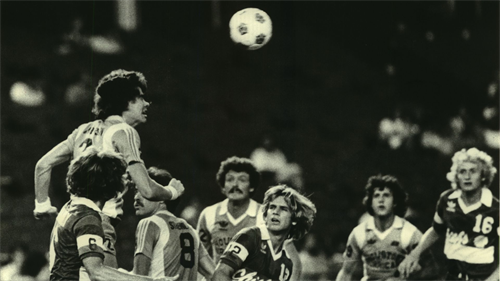
Atlanta NASL
'They signed guys from all over'
But it starts with the history. The Atlanta Chiefs began play in 1967 after Dick Cecil, then an Atlanta Braves executive, helped launch the club. One of their stars, Kaizer Motaung, later returned to South Africa and founded Kaizer Chiefs, taking inspiration from the Atlanta team’s name and identity. Cecil had become intrigued by accounts of the 1966 World Cup and believed professional soccer could work in his city.
Theirs was a particularly strategic venture. At the time, Atlanta was not an immigrant city. So, Cecil recruited from all over. He offered healthy contracts to talented footballers from 14 different countries - on the pretense that they play for six months and coach for the other. That blend helped not only cultivate a fan base but also make for a remarkably effective soccer team. They played friendlies against Man City (and beat them twice). In 1968, they won the first NASL Championship.
“They signed guys from all over,” Longshore explained. “But they all had to speak English, and they signed them to 12-month contracts because they played for six months and they went and they taught the game for six months, and they basically introduced soccer to tens of thousands of kids and people all over the area from like 67 through 72.”
According to estimates, around 150 people in the city were playing organized soccer in Atlanta in 1966. By mid-1968, that number was 16,000.
And then, those kids grew up and started to watch soccer. Longshore was part of the second generation. He watched the 1986 World Cup and remembers being baffled by Maradona’s brace against Belgium in the semifinal (Argentina would, of course, go on to win the tournament).
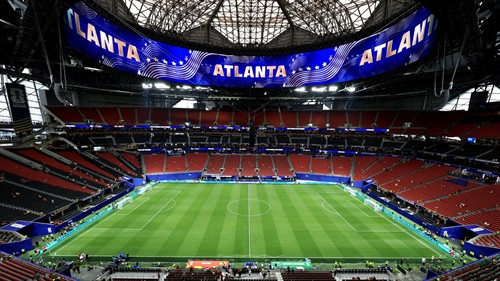
Atlanta Stadium
'No, we're playing at the big stadium'
It was his generation that embraced Atlanta United, too. Their genesis was complicated. There were supposedly ambitions for Major League Soccer to have a franchise in the city in the early days. But with the 1996 Olympics, momentum slowed.
There was also a stadium problem. The Chiefs’ original stadium had since been adopted - and ditched - by the Atlanta Braves, before being demolished in 1997. There was, quite literally, nowhere to play.
When Arthur Blank bought the Atlanta Falcons in 2001, though, he made it clear that he wanted an MLS franchise. By that time, Atlanta was becoming a more diverse place. Soccer was growing again. There was no denying that MLS would someday make its mark in the city. But even that was complicated. The trend in the mid-2000s was to build 20,000-plus-seater stadiums. Blank could have, perhaps, found a tidy suburb and spent big.
But Mercedes-Benz Arena - named Atlanta Stadium for the purposes of the World Cup - was deemed a suitable destination.
“When Atlanta comes in, and they say ‘no, we're playing at the big stadium,’ and Blank is saying Falcons and Atlanta United are the same level, then people had to come at it differently. So you've gotten mainstream coverage that maybe you don't get in other places,” Longshore said.
Winning helped, too.
Atlanta signed Josef Martinez and Miguel Almiron before their inaugural season. They set attendance records immediately, and won MLS Cup in their second campaign.
'It's only going to get so much bigger'
And so a culture was born - one that captured the eyes of those more seasoned in the global game, too.
“When you talk about infrastructure and the thought process behind it, [Blank] wanted to build this super club, and obviously Atlanta's such a hotbed of diversity. You've got absolutely every sort of culture, different nationalities, different people, and I think one thing that obviously football, soccer, does is really unite people,” former West Ham midfielder Jack Collison said.
He moved to Atlanta for ‘something different’ - a job in the club’s youth academy in 2019. Collison has never gone back.
His former club played a friendly in the stadium last year on a preseason tour. And they were shocked.
“It was incredible to have these guys over, and even just speaking to Mark Noble before the game, and one or two of the players, these guys have played at the best stadiums in the world in front of incredible fans. But for them, for a preseason game to go into this stadium and just see how mind-blowing it is, it really sort of sets the scene for some incredible moments,” Collison said.
Other MLS players have bought in, too. Fafa Picault signed for Atlanta United this offseason after winning MLS Cup with Inter Miami in December. He couldn’t be happier.
“You have different aspects to the city, and then you have a big Latin culture that's grown, especially over the last few years, compared to when I used to come play here and visit. Now living here, it's grown tremendously,” Picault said.
It has proliferated beyond the sport, too. The Falcons and Atlanta United share an arena. And the NFL team knows just how impactful the soccer culture can be.
“It's only going to get so much bigger,” Falcons running back Bijan Robinson told GOAL. “And for me, like as a soccer fan, and seeing all these people from other countries here, and like representing their country and taking the time to come on a flight and do all the stuff like that, that's what matters.
It is of little coincidence, perhaps, that U.S. Soccer set up its new state-of-the-art training facility 20 miles south of downtown (a project that Blank funded). The USMNT like that place, too.
"The facilities themselves are incredible. I feel like this is what the national team has needed for a really, really long time... It's a pretty special thing that I think is going to help the national team grow for sure," Tyler Adams said at the start of the USMNT's World Cup camp.
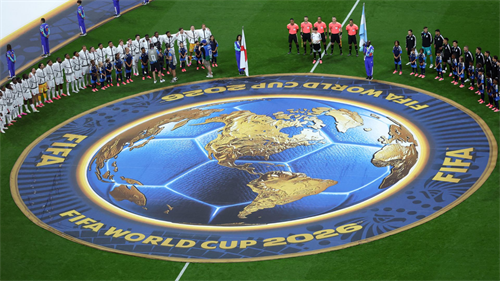
Atlanta Stadium
World Cup successes like no other
The World Cup has been a similar story. Atlanta hosted eight World Cup games. Their fan festival welcomed 500,000 attendees. They retained plenty of the pillars of Atlanta United, too. Hot dogs and sodas could be purchased for $2 apiece. You could get a cheeseburger for $5. So much of this World Cup felt exploitative, a byproduct of the American capitalist system that fans were forced to accept. Atlanta pushed back on that.
"From the beginning of the bid process in 2018, we knew Atlanta and Georgia had everything it takes to host an incredible FIFA World Cup, and our region exceeded every expectation.
“This was truly a team effort, with our host committee staff, civic, community and business leaders, partners, public agencies and volunteers all coming together to create something truly special. We are incredibly grateful to everyone who played a role in showcasing why we are the best city in the world for hosting sports and major events." – Dan Corso, President, Atlanta Sports Council and Atlanta World Cup Host Committee, said in a statement.
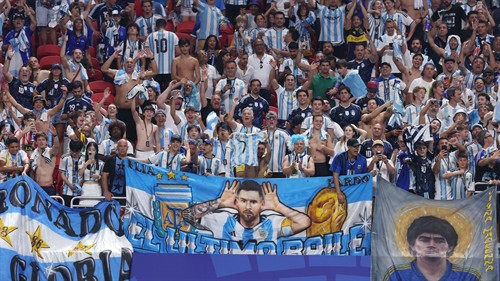
Argentina fans World Cup
'It felt like an away game'
The semifinal was a truly magnificent sporting occasion. Atlanta Stadium feels like another world when you’re inside it. The roof seems thicker. Sounds are contained and then amplified. This is, in other words, a perfect environment for Argentina fans.
Games on a football pitch are not so easily called before kick-off. There are so many variables, so many things that can change. But if this were a sport of vibes and vibes alone, there was a compelling argument to be made that England had lost the semi from before the fan whistle.
Prior to the game, the players lined up for the national anthems. The first note of “God Save the King” just about cut through the noise. And then it was lost in a wall of Argentine whistles. The Argentinian national anthem, meanwhile, was belted.
And then came the drama. This was always going to be a physical, rugged occasion. England-Argentina has a rich history. It also has plenty of animosity. These are two teams that, historically, really want to beat each other. And with every overzealous Argentinian tackle, the crowd came alive. Jude Bellingham reacted to a tackle. The crowd booed him. Elliot Anderson clattered Lionel Messi. The stadium shook in anger. And when Argentina scored two in the last 10 minutes to overturn a 1-0 deficit, Atlanta became what might be the forum for the defining scene of this tournament.
This is, of course, the experience associated with many a South American team. But while other stadiums at this tournament have rather struggled with the chaos, excitement, and often disorganization of Argentine fans, Atlanta created a platform for them to thrive. Thomas Tuchel remarked after England’s 2-1 loss that it ‘felt like an away game.’ He wasn’t wrong.
Yet there was no animosity here among fans. At the end of the night, supporters of both teams milled around bars in the city. In an Irish bar, a 10-minute walk from the stadium, six Argentinian fans sat at a table, plonked their empty souvenir beer cups down on the table, ordered another round, and talked loudly in Spanish. Two England fans, blurry-eyed and stumbling slightly, walked past and shook every hand.
“I hate España,” one of the England fans said to the group of Argentinians.
The table laughed. And then, without anger, they walked out of the bar, onto the bustling street, and off into the night.
There isn’t a better soccer city to lose in.

- Daily
- Weekly
- Monthly
Photos
More»
Hot pics of sexy Raissa Bellini
Thursday July 16 2026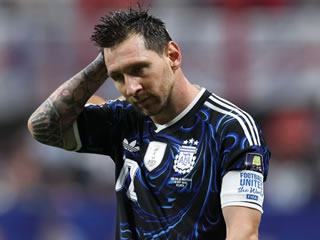
[PICTURE SPECIAL] England 1-2 Argentina
Thursday July 16 2026
Your Say