Hydration breaks are sparking debate, changing the World Cup
Hydration breaks are mandated at every single game of the 2026 World Cup, which has led to mixed reactions from coaches, players and fans alike.
Posted Monday, June 29, 2026 by goal
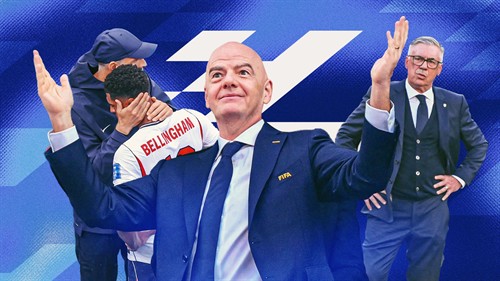
Hydration breaks GFX
Hydration breaks are mandated at every single game of the 2026 World Cup, which has led to mixed reactions from coaches, players and fans alike.
About 30 seconds into a hydration break during the second half of England’s opening World Cup fixture against Croatia, the employees at Dallas Stadium realized they needed to change something.
The boos from England fans were cacophonous. Twenty minutes of fluid play from the Three Lions had been broken up. The fans were making their disdain known. So, stadium staff did what they could, and absolutely blasted “Mr Brightside” around the cavernous arena. Suddenly, all of the bad stuff was forgotten in a boozy singalong.
Yet it also broke up England’s momentum. For the first 20 minutes of the period, they had blown Croatia away. After that, the intensity dropped a little. What seemed on track to be a 6-2 win, ultimately ended in a 4-2 one, with a nervy patch in between. Such is the trade-off of these hydration breaks.
Fans have booed them loudly. The reaction from TV watchers at home is mixed. Managers, it seems, have a love-hate relationship with them. And FIFA have stressed their importance and fairness. More than anything, though, they have become yet another talking point in this most chaotic of World Cups.
"I think that it interrupts and changes the identity of a football match much more than I thought. I had hydration breaks before when it was really, really hot and needed, but they were shorter," Thomas Tuchel said in a press conference prior to England’s group game with Ghana.
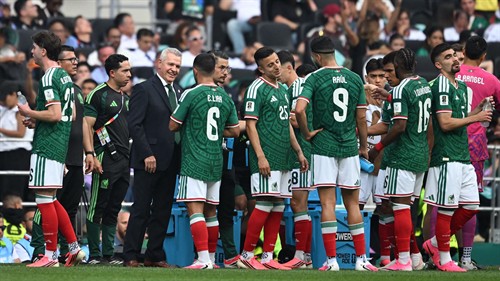
hydration break
'Absolutely, they're necessary'
It has not been uncommon to hear managers refer to hydration breaks during the World Cup. It is a question asked in almost every press conference, in some way or another. Many use it as a recognizable point in the game - basically a mini-half-time. One TV broadcast in the UK referred to a period in the second half of a game as the “third quarter.”
Basically, the idea is that hydration breaks are needed to give players a chance to refuel in long, arduous, high-intensity games. They last three minutes in each half, and are being deployed at every single game across the tournament, regardless of stadium location and weather conditions. FIFA announced them in December after what was effectively a dry run at the Club World Cup last year.
And this has been coming for a while. Hydration breaks are not necessarily a new concept. They were first introduced at the 2014 World Cup, and were mandated for when temperatures exceeded 32 degrees Celsius (about 90 degrees Fahrenheit) In those situations, they make complete sense.
“Absolutely, they're necessary. It's a chance to break up the long play and get some hydration in. We're 70 percent water, and almost all that water is in our cells. If we become dehydrated, we think, ‘Oh, it's our blood that goes dehydrated.’ That's a little bit true, but if our cells and our muscles become dehydrated, they're not going to function as well. That can lead to cramps, and that can lead to all kinds of problems. Overheating is really, really serious,” Chris Minson, Kenneth and Kenda Singer Professor in Human Physiology at the University of Oregon, told GOAL.
You’d be hard-pressed to find a manager who doesn’t agree with that sentiment in theory. Some coaches have given their support to them at this point. Others have voiced concern at past tournaments in the States, not least PSG manager Luis Enrique, who was frighteningly honest about the heat in Pasadena, California, during last year’s Club World Cup.
"The teams are suffering. In terms of play, it's impossible to perform at a very high level for 90 minutes," Luis Enrique said.
More complex than 'heat'
However, determining when, exactly, hydration breaks are needed comes down to more than just heat. Hydration breaks, in theory, should be calculated based on Wet Bulb Global Temperature (WBGT), which takes into consideration temperature and humidity. And it's there when the real need for hydration breaks can be calculated.
"To simplify it, say if it's sunny and it's humid and there's, and it's hot, you're going to have a high WBGT, and that's going to increase risk," Minson explained.
A combination of both humidity and heat, in fact, can be outwardly dangerous. The body, in effect, starts to shut down.
"We've got these conditions where we are going outside of what humans can tolerate for long, playing it at intense levels. When it's humid, we can't evaporate, our sweat is dripping off us. If your sweat does not evaporate, you're not dissipating heat. And then you're losing all that fluid, plus you're dehydrating your cells and then you start having problems," Minson said.
USMNT manager Mauricio Pochettino stressed that, in certain situations, there is no other alternative, though, after playing an early-afternoon game in Seattle.
"I think it was necessary," he said. "It was really hot and it was good to have the water to help both teams in recovery."
It's hard to argue with the science there. FIFPro, the international soccer players' union, has used similar data to advocate for the usage of cooling breaks in conditions when the WBGT goes north of 28 degrees Celcius.
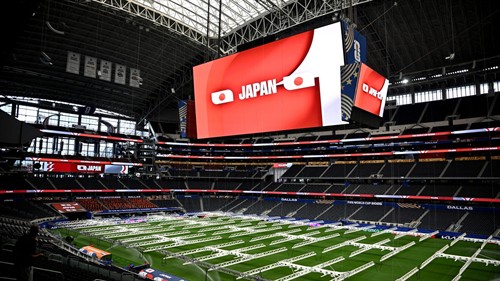
Dallas stadium japan netherlands world cup groupf match day1
'People have been playing soccer in those conditions for years'
That seems a no-brainer. Yet the challenges come when conditions aren't so adverse. When England played Ghana in Boston, the WBGT hovered between 18 to 21 degrees Celsius over the course of the game. It was a cloudy, spitty day in Foxborough, Massachusetts - a remarkably English summer day, in fact. Scientifically, there was little sense in having a hydration break. Yet in the 22nd and 67th minutes, the referee called for the players to shuffle over to the sidelines, regardless.
"Do I think a hydration break is needed if it's 82 degrees, and it's raining, or it's not very sunny? No. I mean, people have been playing soccer in those conditions for years, decades, and whatnot, and being totally fine," Minson said.
It gets even more contentious during games that are held indoors, in climate-controlled stadiums that are protected from the sun. Those places - Dallas, Atlanta, Los Angeles, to name a few - have quite literally been designed to ensure that American Football teams are able to play without worrying about heat.
Yet the line from FIFA is that there should be standardization across all games. Hydration breaks, then, are a World Cup wide proposition, regardless of where the game is being held.
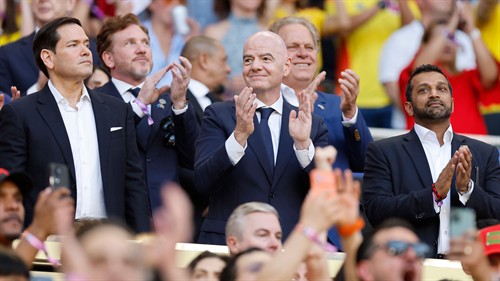
“What matters even more to us is ensuring that all teams, in every match, are playing under the same conditions," FIFA President Gianni Infantino said.
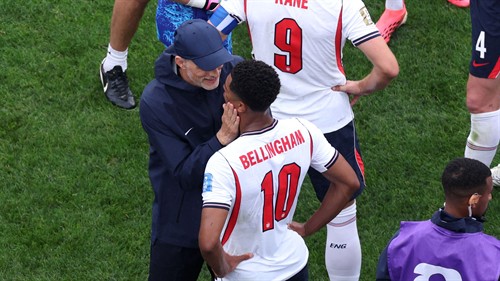
England v Ghana: Group L - FIFA World Cup 2026
The coach's perspective
Over the course of the tournament, coaches have often referred to hydration breaks as possible turning points during games. Carlo Ancelotti highlighted his team's improvement following the first half hydration break in their eventual 3-0 win over Haiti. It was 0-0 at the time of the break. Matheus Cunha bagged the Selecao's opener almost immediately after.
"We have a possibility for player recovery, and you can also put some adjustments on the game," Ancelotti admitted following the contest.
Haiti manager Sebastien Migne also acknowledged that it was a good time to check in with his players and reinforce a message.
"We had the cooling break, and we were actually aligned with what we anticipated," Migne said.
And that is the point. These breaks, which are nearly three minutes long, have been used effectively as timeouts by managers. It is a common sight to see Tuchel, Ancelotti, and others barking instructions as their players take a sip of water or have a cold towel placed on their neck.
Tuchel went as far as to say that he considered restructuring England's whole attacking system against Ghana - before deciding that such a drastic change might be too much in the middle of the game.
"I had an idea in the last water break, but I was a bit hesitant. But there is an idea how we can maybe also commit a little bit more players through the middle. Maybe we will try it later in the tournament," Tuchel said at full time.
Still, the fact that he had the opportunity to do so speaks volumes to the potential impact of these things.
"I'm a coach, and I can connect with my players and have some instructions and alerts," he said.
FBL-WC-2026-MATCH66-URU-ESP
Breaking up play
However, soccer has always been a free-flowing sport. A complaint often levied during the Premier League last year was the way that teams would slow play down in order to set up set-pieces, or draw up elaborate long throw-in routines. Arsenal, in fact, won the league by having the ball in play for less time than over half of the teams in the league.
That is seen as anti-football by some. And hydration breaks take things to the extreme. Momentum matters in football matches. That fact is even more pronounced in international games, when movements are less choreographed, and teams tend to rely on spells with and without the ball.
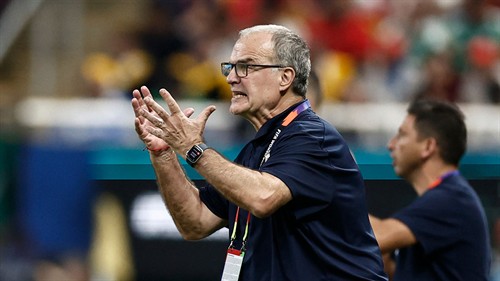
Perhaps the manager who spoke most angrily about it was Marcelo Bielsa of since-eliminated Uruguay. His philosophy has been dubbed "murder ball" for its high intensity and relentless running. Bielsa's idea is to win the ball back and shuttle it forward as quickly as possible. In effect, his players never stop running. When it works, it is remarkably effective.
It is no wonder, then, that Bielsa was angered by their usage.
"In my view, it adds nothing and takes away a lot. When [the match] was divided into four periods, no thought was given to the effect it might have on what makes football such a captivating sport, but instead to other repercussions which I'm neither discussing nor analysing," he said before his team's fixture with Cape Verde.
Germany's Kai Havertz, who is also part of a side that emphasizes pressing and movement, expressed his distaste.
"They’re usually annoying, especially when you’ve just had two or three good situations and feel your flow is being interrupted,” he said.
Even Tuchel, despite acknowledging their usefulness, admitted it was a break from tradition.
"I liked football more when it was two halves," he said.
Colombia v Portugal: Group K - FIFA World Cup 2026
'This is not a financial issue for us'
The Club World Cup offered an early indicator of where this all might have gone. During last year's tournament, DAZN, which had the broadcast rights to the competition, ran half-and-half ads during breaks. They paid a reported $1 billion for the rights to the tournament, and claimed that they planned to make around $300 million back in advertising (it's not clear whether that estimate held true).
This year, FOX has gone one further, cutting away from games entirely for carefully-timed ad breaks (most of which feature some hilariously American commercials). Over the course of the tournament, that will be an immensely lucrative venture. The Hollywood Reporter reported that Fox could make around $300m from commercials alone. But those ads have sometimes impacted the actual broadcasts, with FOX coming off ads when play had already resumed.
Yet, not every broadcaster has followed suit. Telemundo has insisted they will not have ads during the breaks, stressing, "This World Cup is ours - we’re not taking a break from it." And FIFA, it must be admitted, will not make a cent from breaks.
"There is no additional revenue for FIFA, as all commercial agreements were signed well in advance. This is not a financial issue for us. For us, it is purely a sporting matter," Infantino said.
However, there is a clear connection here. Ad breaks lead to sponsorships. Sponsorships put money back into the ecosystem. And with football associations and clubs needing to find new ways to make revenue, could this ultimately be another way to supplement that?
And perhaps that's the bit that stands out the most. Soccer has tried to resist commercialization, and spent years - if not decades - steadily failing. Shirt sponsorships, corporate involvement, massive ad deals - these have all tainted the perceived purity of the game off the field. There was hope to be found that the on-field stuff could be kept sacred. But now, even that feels a little less certain.
-
World Cup

- Daily
- Weekly
- Monthly
Photos
More»
[PICTURE SPECIAL] Jordan 1-1 Argentina
Sunday June 28 2026
World Cup fan's busty display in eye-popping top
Sunday June 28 2026
Ex-Miss Croatia shows true colours
Sunday June 28 2026
Your Say