World Cup's unfair format plays right into Infantino's hands
The unfair format of the 2026 World Cup is likely to be exposed this week, but that could actually be a positive thing for FIFA president Gianni Infantino, who wants to increase the competition to 64 teams
Posted Thursday, June 25, 2026 by goal
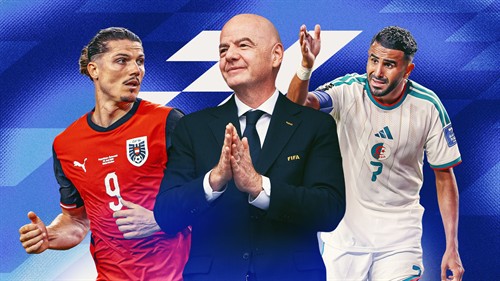
World Cup farcical format GFX
June 25, 1982 was, according to The Times, "the day that sportsmanship died". What was expected to be a fiercely competitive fixture between West Germany and Austria became a 'non-aggression pact' between two teams who effectively stopped playing during the second half of their World Cup group game in Gijon to ensure that both progressed to the second round.
The Germans had gone into the match sitting third in Group 2 primarily due to a shock 2-1 loss to Algeria in their tournament-opener. Consequently, nothing less than a win would suffice for Jupp Derwall's men, and they took a 10th-minute lead in Gijon through Horst Hrubesch.
However, Austria, having won their first two games, knew that so long as they didn't lose by three goals or more to the Germans, they would still pip Algeria to second place in Group 2 on goal difference. Why? Because Algeria had played their final game, against Chile, the previous day, meaning the precise permutations had been established before kick-off.
With no great incentive to secure a draw that would have eliminated neighbours West Germany, Austria didn't even attempt to attack in the closing stages. When fans in the ground realised what was happening, some began burning banknotes while chanting, "It's a fix!"
Meanwhile, Austrian commentator Robert Seeger asked viewers to switch off the TV, while his German counterpart Eberhard Stanjek simply stopped talking. Former Germany international Willi Schulz subsequently called all 22 players on the field "gangsters" and, the following day, Gijon newspaper El Comercio even printed its match report in its crime section.
However, while the Algerian Football Federation (AFF) called for an investigation, FIFA found that nobody had actually broken any rules, which is why they felt compelled to change them. Ever since the 1982 World Cup in Spain, the final two fixtures in each group have kicked-off on the same day and at the same time. It's, therefore, puzzling that FIFA has facilitated a possible repeat of what became known as 'The Disgrace of Gijon' at the 2026 tournament in North America...
FBL-WC-2026-MATCH04-USA-PAR
'Every idea is a good idea'
At the 75th FIFA Congress in Paraguay last year, Gianni Infantino said that "every idea is a good idea" - a statement that help explains why we're presently watching a World Cup with an inherently unfair format.
Increasing the size of the tournament from 32 to 48 teams was, of course, a decision motivated by money and power. More teams meant more revenue, for FIFA and all of its members, thus solidifying Infantino's position as the organisation's undisputed president. No thought was given to how the expansion would negatively affect the competition.
Indeed, it only dawned on Infantino & Co. after a wildly exciting group stage at the 2022 World Cup that their initial plan for 16 groups of three teams in 2026 would not only rob the tournament of final-round drama, but also raise the possibility of teams playing out mutually favourable results, given they'd already know exactly what was required to proceed to the knockout stage.
Japan v Spain: Group E - FIFA World Cup Qatar 2022
Revised format
"Here, the groups of four have been absolutely incredible," Infantino admitted in Doha. "Until the last minute of the last match you would not know who goes through."
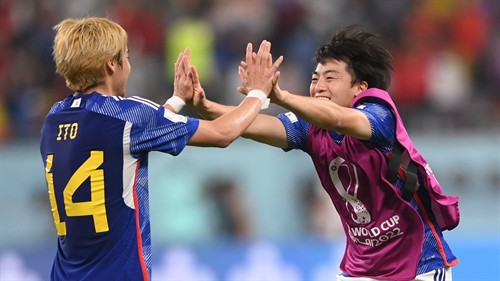
For once, he wasn't wrong. In Group E, for example, there were nine changes to the standings over the course of the two matchday-three games between Japan and Spain, and Germany and Costa Rica, which were obviously played simultaneously.
Consequently, Infantino admitted that FIFA would have to "revisit or at least re-discuss the format" - and they did. In March of 2023, the FIFA Council confirmed that the 48 participants in the 2026 World Cup would be divided into 12 groups of four.
"The revised format mitigates the risk of collusion and ensures that all the teams play a minimum of three matches," a statement read, "while providing balanced rest time between competing teams."
Unfortunately for FIFA, the change created another problem - because of simple mathematics.
Scotland v Brazil: Group C - FIFA World Cup 2026
'Rewarding mediocrity'
The great thing about a 32-team tournament is that it's easily whittled down to a last 16 by having the top two teams in all eight groups progress to the knockout stage. So simple, and so fair. Everyone knows where they stand at all times, and results in one group do not affect another - unlike in the current World Cup.
The 2026 expansion to 48 teams meant that FIFA had to allow third-placed teams to go through (eight in total) to make up the numbers for a round 32 - and that has had two predictably dreadful consequences.
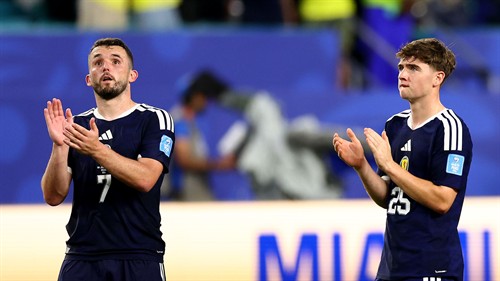
Firstly, teams can go through despite losing two of their three group games - which, as former Scotland international Craig Burley said of his country's potential progression thanks solely to a 1-0 win over Haiti, "rewards complete mediocrity". Secondly, and far more seriously, the use of a third-placed table for the first time since 1994 increases the possibility of the very collusion that FIFA tried to eradicate in 1982.
Saturday's Group J clash between Austria and Algeria is the perfect case in point - and not just because it features two of the three teams caught up in 'The Disgrace of Gijon'.
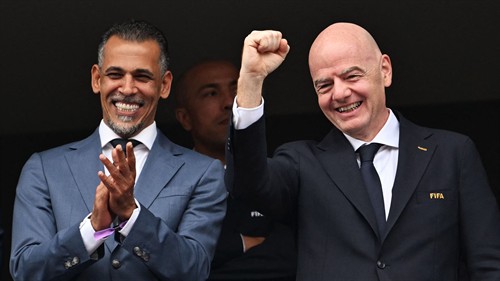
FBL-WC-2026-MATCH42-FRA-IRQ
Ruining the spectacle
While both teams have lost to group winners Argentina but beaten Jordan, Austria are ahead of Algeria because of their superior goal difference. In normal circumstances, Algeria would have to go all-out to beat the Austrians in order to qualify for the knockout stage.
However, because they're playing in the final timeslot of the group stage, Algeria already know that a point in Kansas City will be enough to progress.
Given a draw would also seal second spot for Austria, they're under no pressure whatsoever to try to win the game. On the contrary, it might actually be beneficial for them to lose it - because FIFA made a second shocking change to the format of the 2026 World Cup not long before it kicked-off.
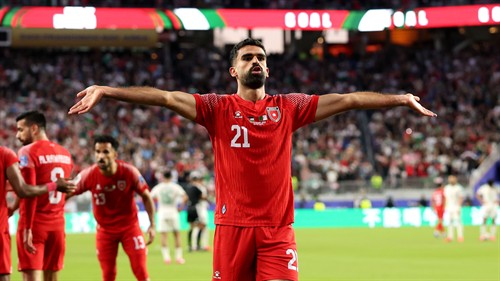
Jordan v Algeria: Group J - FIFA World Cup 2026
Fundamentally flawed
For the first time ever at a World Cup, the primary tie-breaker for teams that finish on the same points in the group stage is the result between the two teams, rather than goal difference. That's resulted in the early elimination of five sides that would have still been in with a chance of finishing third, thus completely contradicting FIFA's supposed drive to ensure as few dead rubbers as possible.
Jordan were one of the teams affected by the tie-breaker tweak, meaning there's no risk of either Austria or Algeria finishing bottom of Group J, removing a massive amount of jeopardy from their encounter in Miami. Worse still, due to the fact that every other group will already be decided by the time they kick off, both teams will know their potential opponents in the round of 32, and that could also influence the outcome.
As it stands, the runners-up in Group J would play Spain, whereas the third-placed team could face Switzerland. Clearly, Austria would much rather avoid a round-of 32 meeting with the reigning European champions, so it's not actually in their interests to avoid defeat against Algeria.
Obviously, there's been nothing to suggest that Ralf Rangnick will instruct his players to throw the game - but that's not the point. The point is that by virtue of the fundamentally farcical format, Austria and Algeria are both in a far more advantageous position than nearly all of their rivals for a spot in the knockout stage.
Tunisia v Japan: Group F - FIFA World Cup 2026
Controversial solution
It should not be forgotten, either, that allowing third-placed teams to progress also means that some group winners will get a much tougher draw in the round of 32 than others. It's all grossly unfair and the sensible solution would be to return to a 32-team tournament.
However, it's actually far more likely that FIFA will instead favour further expansion. Just last year, Uruguayan football official Ignacio Alonso "spontaneously raised" the idea of a one-off 64-team tournament for 2030 to mark the World Cup's centenary.
Despite subsequent support from CONMEBOL president Alejandro Dominguez, there's been a lot of resistance to the proposal, mainly from UEFA and the AFC, while it's also been reported that it doesn't even have a huge amount of support behind the scenes at FIFA either, which is slightly reassuring.
As well as further diluting the quality of the finals, a 64-team World Cup would be an even bigger logistical and environmental disaster than the current competition. Tellingly, though, Infantino hasn't yet ruled it out - which is not in the least bit surprising. At FIFA, every idea really is a good idea - no matter how terrible.
-
World Cup

- Daily
- Weekly
- Monthly
Photos
More»

Hot pics of COLOMBIA'S superfan Wendy Sanchez
Thursday June 25 2026
[PICTURE SPECIAL] Scotland 0-3 Brazil
Thursday June 25 2026
Your Say