One year out: Five biggest stories for 2027 Women's World Cup
One year out from the 2027 Women's World Cup, five storylines are already shaping Brazil’s big moment, the USWNT’s title hopes and the chasing pack.
Posted Wednesday, June 24, 2026 by goal
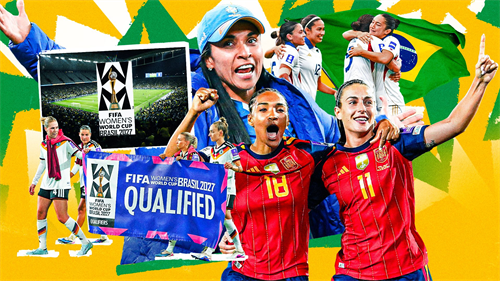
Women's World Cup GFX
One year out from the 2027 Women's World Cup, five storylines are already shaping Brazil’s big moment, the USWNT’s title hopes and the chasing pack.
One year from now, the FIFA Women's World Cup will take place in Brazil, marking the first time the women's tournament has ever been staged in South America.
Eight cities and some of the continent's most iconic stadiums, including Arena Castelão in Fortaleza and Estádio do Maracanã in Rio de Janeiro, will welcome 32 nations between June 24 and July 25.
With one year to go, many of the tournament's biggest questions remain unanswered.
Hosts Brazil have already secured their place, joined by Australia, China PR, Japan, Korea DPR, Korea Republic, the Philippines, Argentina, Colombia, New Zealand, and Germany. Elsewhere, European powers Spain, France, and Denmark have also booked their spots. But while the field is beginning to take shape, much of Africa, North America, and Europe still has work to do in upcoming competition windows.
The next major qualification stretch arrives later this year. Europe's playoffs will run from October through early December, while Africa's places will be decided at the Women's Africa Cup of Nations, which begins July 25. Concacaf's qualifying tournament follows in November, meaning many of the world's biggest teams, including the U.S. women's national team, still have work to do before their place in Brazil is secured.
Then there is the bigger question: Is Brazil truly ready to host a Women's World Cup?
The country boasts world-class infrastructure and legendary football heritage, but FIFA and local organizers still face the challenge of delivering a tournament that leaves a lasting legacy for the women's game. There is also the question of where women's football sits within Brazil's sporting identity. This is the home of Marta and one of the richest football cultures in the world, but the women's game has long existed in the shadow of the men's national obsession.
Questions around scheduling, travel, fan experience, tournament favorites, and potential dark horses will soon take over the conversation. And after the men's tournament this summer, there will be lessons to absorb, too. The road to Brazil 2027 is already underway - and these are the five stories that will define it.
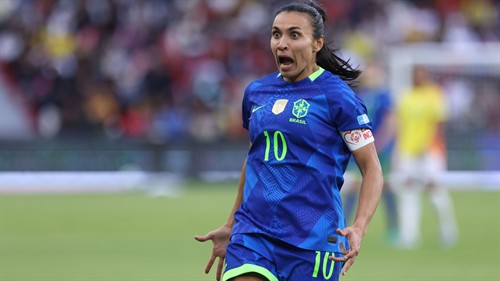
Colombia v Brazil - Copa America Femenina 2025: Final
Is Brazil ready to host?
Brazil hosted the 2014 FIFA Men's World Cup, which, given infrastructure, scheduling, and just overall scale of operating the biggest football tournament in the world, has proven they can do it. While this will be the first time a South American country will host the Women's World Cup, and many parts of the tournament are different than the men's, operationally, the host cities in Brazil should be ready.
The host city selection process for the 2027 FIFA Women's World Cup began back in August of 2024, with specialized personnel visiting various 12 candidate cities where they would evaluate the facilities and any proposals for building. Based on a predefined criteria, FIFA decided on the eight host cities and stadiums.
The eight stadiums confirmed were also used for the 2014 Men's tournament: Belo Horizonte (Estádio Mineirão), Brasília (Estádio Nacional), Fortaleza (Arena Castelão), Porto Alegre (Estádio Beira-Rio), Recife (Arena de Pernambuco), Rio de Janeiro (Estádio do Maracanã), Salvador (Arena Fonte Nova) and São Paulo (Arena Itaquera).
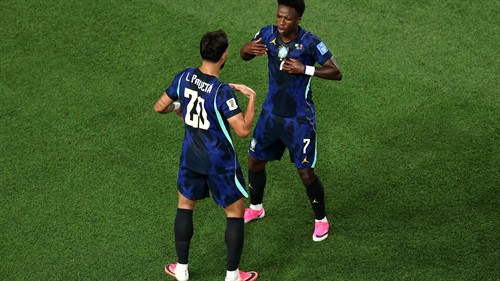
Brazil v Haiti: Group C - FIFA World Cup 2026
Where does women's football sit in Brazil's sporting identity?
Historically, women's football in Brazil has been sustained through community games, grassroots collectives and organizations that are embedded within communities. While the Brazilian women's national team has long been highly regarded for their impressive runs across world tournaments, finishing as the runner-up in 2007, capturing third place in 1999, women were completely banned from football from 1941 to 1979. For a country that is responsible for bringing up some of the best female footballers of all-time, names like Marta, Formiga, and Pretinha, women's football and acceptance of it, still has a very long way to go.
According to Common Goal (the home of football for good and a partner of FIFA women's football), women's football in Brazil continues to face a number of obstacles.
“Growing up in Brazil, I dreamed that one day the FIFA Women’s World Cup would be played here. We now have a once-in-a-lifetime opportunity to ensure the tournament is not only a celebration of elite football, but the true legacy will depend on what happens beyond the stadiums," Julia Pimenta of Common Goal said. "Across Brazil, grassroots organizations have been creating opportunities for girls through football long before the spotlight arrived. Equal Play Effect is about strengthening those communities and ensuring football becomes a lasting platform for gender equity and social change."
The U.S. women's national team faced Brazil in Brazil in June, and the packed stadiums were only a teaser to how many people will get up, come out to watch women's football. Across the two games, the matches drew in over 86,000 fans combined.
Football is a piece of Brazilian DNA; however, the fight for support and equality, and how women's football is perceived, continues to be a work in progress.
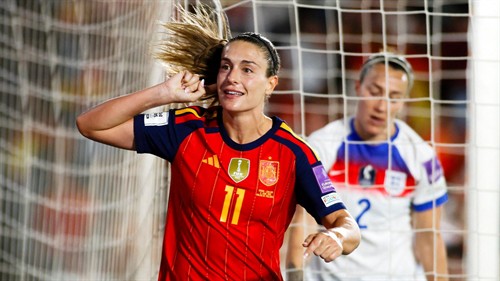
Alexia Putellas Spain Women 2026
Who are the early favorites?
It is tempting to pick a winner now, but a year out from a World Cup, certainty is hard to come by.
Twelve months before the 2023 Women's World Cup, few would have predicted Spain would arrive in Australia amid internal turmoil and leave as champions. Four years earlier, the United States looked untouchable as it defended its crown in France. England and Germany remain among Europe's heavyweights, while Brazil will have the advantage of hosting, with packed stadiums, familiar surroundings and the emotion of a home crowd behind them.
As it stands, the earliest favorites can only really be measured by recent success, star power and tournament pedigree. That puts the United States near the front of the conversation, with four World Cup titles and a 2024 Olympic gold medal. Spain belong there, too, as reigning world champions and with Aitana Bonmatí and Alexia Putellas still among the game's defining players.
England, coming off back-to-back European championships, cannot be overlooked, while Germany's World Cup history keeps them firmly in the picture. And then there is Brazil, a team still searching for its first Women's World Cup title but backed by home-field advantage and the legacy of Marta, the tournament's all-time leading scorer with 17 goals. Just behind her on the all-time list is Germany legend Birgit Prinz, with 14.
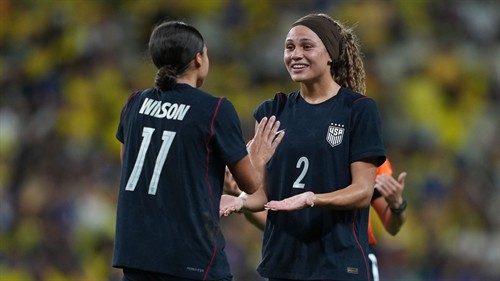
Sophia Wilson, Trinity Rodman, USWNT
Where do the USWNT stand?
The USWNT are in a strong position, even if they have not qualified yet.
Their recent showings in Brazil, against Brazil, offered another reminder of both the team's ceiling and its depth. Emma Hayes has not shied away from testing that depth, either, using this cycle to look at different combinations, age groups, formations and positional battles before the games start to truly count.
The biggest challenge now may be availability. Hayes can only select players who are fit, and keeping key pieces such as Naomi Girma, Catarina Macario and Rose Lavelle healthy will be essential if the U.S. is going to reach its highest level by tournament time.
By the time qualifying arrives this fall, Hayes and the USWNT will have had nearly two full years of building since the 2024 Olympics. That should leave them well-positioned for the pressure of Concacaf play, especially after a cycle built around experimentation and preparation for different scenarios.
The USWNT will face El Salvador in the Concacaf W Championship quarterfinals on Friday, Nov. 27, at Texas Health Mansfield Stadium in Mansfield, Texas. A win would send the U.S. to the semifinals and secure its place at the 2027 Women's World Cup.
Will FIFA learn its lessons from 2026?
After the expanded 48-team men's World Cup in North America, FIFA will have plenty to take into Brazil 2027.
Of course, the circumstances will be different. Brazil is one country rather than three, and the Women's World Cup will be played across fewer venues. But the broader questions around travel, scheduling, stadium access and fan experience will still matter. A tournament spread across eight cities still requires careful planning, especially for teams, supporters and media moving from one match to the next.
Player welfare will also be a major part of the conversation. Extreme heat, congested schedules and long travel demands have become recurring concerns across major international tournaments, and Brazil will need a clear plan around kickoff times, recovery and climate conditions in each host city. Depending on conditions, hydration breaks and other in-match measures could again become part of that discussion.
Off the pitch, ticketing will be another area to watch. FIFA's push for commercial growth has helped elevate the women's game, but Brazil 2027 will also need to feel accessible to the supporters who have long carried it. Premium hospitality and higher-priced tickets may be part of the modern World Cup model, but they cannot come at the expense of the atmosphere and community that make the tournament feel alive.
Brazil in 2027 gives FIFA a chance to show that growth and accessibility can exist together. The challenge will be delivering a tournament that feels commercially ambitious, but also sensible in its scheduling, welcoming to supporters, and built with player welfare in mind.
-
World Cup

- Daily
- Weekly
- Monthly
Photos
More»
Hot pics of Elizabeth Marie Chevalier
Wednesday June 24 2026
[PICTURE SPECIAL] England 0-0 Ghana
Wednesday June 24 2026
Your Say