Why the USMNT's 1994 World Cup run is more important than ever
GOAL dives into the summer that changed the sport of soccer with stories from those who lived it
Posted Thursday, June 11, 2026 by goal
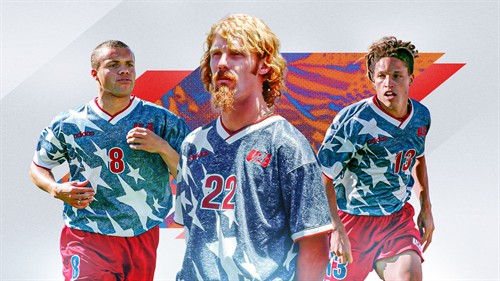
Summer of 1994 GFX
GOAL dives into the summer that changed the sport of soccer with stories from those who lived it
On the day the U.S. Men's National Team lost to Brazil at the 1994 World Cup, Cobi Jones realized something: they'd already won. The team's World Cup dream had ended, but Jones' was just beginning. It was on that Fourth of July afternoon, under the sun and in front of more than 80,000 fans, that Jones looked around and saw the future.
"Across the way are Romario and Bebeto," Jones recalls to GOAL. "Coming out and just hearing the eruption of the crowd and just the amount of American fans that were there with painted faces wearing red, white, and blue, and throwing the flags up in the air. They dwarfed the Brazilian fans. That was a special moment for me. I'll never forget it. It just showed me that the game had been accepted."
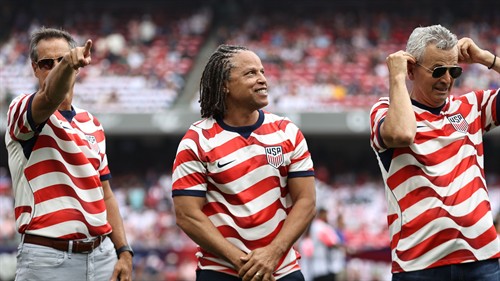
Thirty-two years later, Jones and 14 of his teammates walked onto the field of a different stadium. Prior to the kickoff of the USMNT's send-off game for the 2026 World Cup, the 1994 group was honored at Soldier Field. They'd all traded denim kits for red and white stripes. They traded shin pads for aviators and slide tackles for cellphone selfies. Much had changed in 32 years, but, as they reunited to kickstart another sport-defining summer, everything seemed to come full circle.
The start of that began over three decades ago when a group of 20-something nobodies was asked to inspire a country. It began with limited soccer culture, no professional league, and no hope. It was during that summer of 1994 that everything changed, though. It was during that summer that that group of nobodies became icons, played against the world's best, met the most famous faces of the '90s, and signed a whole bunch of autographs.
More importantly, though, that summer was when soccer truly arrived in America. Major League Soccer was born out of the promise of the 1994 tournament. Three decades later, it has Lionel Messi and clubs now valued alongside some of the biggest teams in European soccer. As the World Cup returns to the United States in 2026, so much of what the sport has become here can be traced back to that summer.
"There was no looking back after that," Alexi Lalas tells GOAL. "World Cups were never the same after that."
This is the story of that 1994 World Cup from those who lived it, those who benefited from it, and those whose lives were changed seemingly overnight.
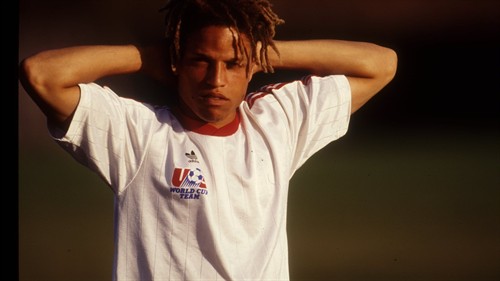
IST OCT 1993: COBI JONES IN TRAINING AT MISSION VIEJO. JONES IS A MEMBER OF THE USA SOCCER TEAM FO
'There was no soccer'
It's hard for the younger generation to fathom, but there was once a time when soccer was not a major part of American culture. It wasn't even a minor part. It was hidden away among small groups of outcasts. In Jones' case, it was tucked into the back of restaurants, watching something no one else wanted to see.
"We'd pay the five bucks to get into a Mexican restaurant," Jones tells GOAL. "You're shoved into a back room where they have bad satellite and those wavy lines. Everyone's crowded around the TV trying to watch the game. That was it. That's how it was. There was no soccer."
On July 4, 1988, that began to change. It was on that day that FIFA's Executive Committee met in Zurich to determine the hosts of the 1994 World Cup. It took just one round of voting for the U.S. to win. As part of that vote, FIFA mandated that the U.S. create its own professional soccer league after breaking tradition by naming its first World Cup host without one.
By awarding the World Cup to the U.S., FIFA hoped to create increased interest in the sport. That was guaranteed because, at that time, interest was at roughly zero.
The USMNT, meanwhile, was suddenly thrust into the spotlight. In 1990, the U.S. qualified for the World Cup for the first time in 40 years but were swiftly dispatched with three straight losses. In order to prepare for the 1994 tournament, U.S. Soccer took a leap that is unfathomable by today's standards. With no professional league for American players to play in, the federation essentially turned the USMNT into a club team. The players would be based in California and train under head coach Bora Milutinovic full-time. For several years, American soccer's top stars' sole focus was the World Cup.
"People don't realize that when guys like myself and Cobi Jones stepped on the field in 94, we had never been on the books of a club team," Lalas tells GOAL, "and so we did it completely backwards. Normally, you're in the youth system of a club, and then you get put into the first team. You do well, the national team sees you, you go and you do well or whatever. That's the pathway. For us, we trained two years before the World Cup as an actual team out of necessity, because none of us had club teams."
Many of the USMNT's top stars came through that system, Jones, Lalas, and Marcelo Balboa among them. In total, 14 of the 23 players in the final World Cup squad were part of that program. Nine weren't. That group included Tab Ramos, Earnie Stewart, John Harkes, and Eric Wynalda. It was awkward, at least initially.
"You had a group that became very tight that was based here in the U.S.," Jones says, "and then, at times, these guys coming from overseas came into the fold as well. It was an interesting dynamic. It was two separate groups that became one right before the World Cup, and then just kind of bonded because even within that, those two groups coming together, there was still the idea of, 'Okay, how do we succeed as a group?'"
Success was anything but guaranteed. The U.S. entered that summer as the 23rd-ranked team in the competition. They were drawn against two European heavyweights, Switzerland and Romania, as well as Colombia, one of the best teams in South America.
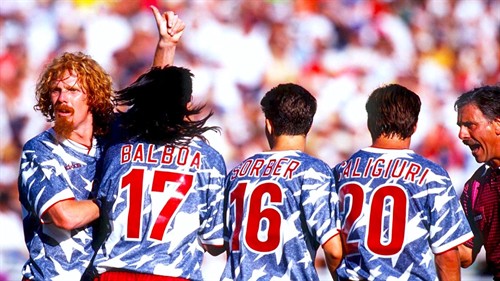
Alexi Lalas 1994 USMNT
Defying expectations
From the moment the group was drawn, members of the team had one real thought: don't get embarrassed. They would be underdogs in all three games, which meant there was a very real possibility that the USMNT's defining moment could be over pretty quickly.
"There was a lot of pressure on us not to be the first host nation that didn't get out of the group stage," Jones added. "There was a lot of bonding in that, I guess you would say. It's like a shared sacrifice or shared pain, whichever way you want to look at it, to find a way to get things done."
Added Balboa: "Listen, there were no expectations."
That quickly changed.
The first match was against Switzerland in front of over 73,000 fans in the Pontiac Silverdome. That support itself was something of a victory. The result was a moral victory, too, as the U.S. earned a 1-1 draw thanks to a Wynalda goal just before halftime.
Up next was one of the most infamous matches in the sport's history. On June 22, 1994, the U.S. defeated Colombia, 2-1, at the Rose Bowl. Stewart was the USMNT's hero with the eventual game-winner. The first goal, famously, was an own goal from Andres Escobar. The Colombian defender was murdered shortly after the tournament.
With four points in their back pocket, the U.S. were able to advance despite a 1-0 loss to Romania in the group stage finale. They had defied all the odds, impressing the rest of the world with their grit, spirit and, ultimately, soccer ability.
"I admired the U.S. team," Jurgen Klinsmann, who starred for Germany that summer and ultimately coached the USMNT at the 2014 World Cup, tells GOAL. "We watched all the games on TV, and I remember that we talked a lot about the U.S. team. I saw a team that was playing their hearts out, a team that had fantastic football players: Tab Ramos, Alexi Lalas, Tony Meola, Marcelo Balboa. It was a team that could easily compete with the rest of the world.
"We always thought, 'Okay, how popular is soccer really in the U.S.? How far can they take it?' That was a team that could have taken it easily to the semifinals, not because it was a surprise, but because they were so good."
They didn't reach the semifinals. As a reward for escaping the group, the USMNT was paired with Brazil. They gave the eventual champions all they could handle before succumbing to a Bebeto goal in the 72nd minute. And so the 1994 World Cup dream had ended - except it hadn't. For the players on that team, 1994 wasn't a summer, but rather a turning point. Their lives would never be the same.
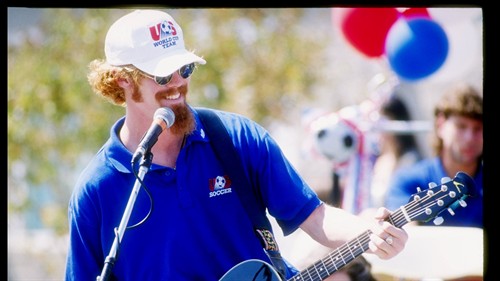
Alexi Lalas
Overnight celebrities
American soccer had never had a true superstar. After that summer, there were 22. Almost instantly, the members of that 1994 World Cup team had earned celebrity status after being relatively anonymous leading up to the tournament. In just a few short weeks, everyone wanted to be the USMNT. Everyone wanted to look like them, too.
"They love the uniform, let's be honest," Balboa says of the iconic denim kit that, to this day, is one of the game's most beloved. "That jean shirt? Everybody seems to be dying to get it."
Lalas, with his red hair and goatee, became iconic. Jones' stardom on the field led to stardom off of it. Captain Meola started a legacy at the goalkeeper position. Every player in the squad seemingly brought something different to the table, and each developed their own cult followings.
"As Alexi loves to point out, I had a lot of the teen girls screaming for me," Jones says with a laugh. "Alexi had the rebels."
"That group had a personality," Balboa adds, "and I think that's what made that group kind of special. That's why people attach themselves to that 94."
There were perks to it, and some of them were quite surreal. After that World Cup, Jones recalls getting bumped into first class on flights when recognized by airline crew. Players suddenly had support all over the country. Fans, of both soccer and of the team in general, popped up everywhere as players suddenly dealt with the concept of fame.
"I think it was a little bit of a shock for us," Jones says, "because we started to realize how much bigger it could be. When you start getting the television interviews, magazine covers, Sports Illustrated for Kids - it slowly ramped up. Every game that we went to, I would say we would have at least 500-600 balls that we would have to sign in the various ballrooms at the hotels.
"We weren't just soccer players. Look, you're 23 or 24 and, yeah, you're loving all the attention, but it was also challenging at times with all the asks that you had to do beyond just the soccer because you had to help build the sport."
By building the sport, the USMNT ultimately crossed paths with 90s icons. After the loss to Brazil, Robin Williams came into the meal room to address the team.
"I think everybody was like, 'What the hell?'," Jones says.
Williams wasn't the only icon Jones got to meet that summer. His favorite interaction came after the USMNT's opening-game draw.
"Being born in Detroit, I always think about this," Jones says. "After the game in Detroit, someone brought me up to the family room and someone from Adidas, said, 'Hey, someone wants to meet you'. They took me over, and it was Barry Sanders. 'Hey, man, nice to meet you' and he says, 'Man, you're fast'.
"I was just like, 'Wait, what?' That's coming from Barry Sanders! It was a special moment for me. That was one of those odd moments where I was like, 'Yeah, this is pretty amazing'."
Sanders was far from the only one impressed by Jones and his teammates. As it turns out, there was a whole new generation of athletes watching, and that summer was the spark that ignited their own interest in the sport.
Belgium v USA: Round of 16 - 2014 FIFA World Cup Brazil
The generation watching on
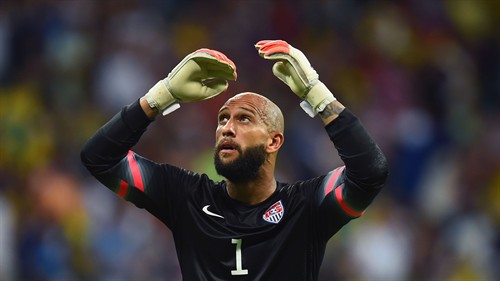
In the summer of 1994, Tim Howard was 15. He was, at the time, with the U.S. U-17 men's national team training in California. U.S. Soccer was kind enough to get the group tickets to see the USMNT play Colombia. Howard remembers every detail.
"Here I am, 15 years old with my U.S. national team buddies," Howard told reporters in 2024. "Our shirts are off, we're sweating in the Pasadena heat, we've got USA painted on our faces. We're behind the goal, and Marcelo Balboa misses a bicycle kick, but obviously we win on the own goal.
"To see them parading around the field with American flags, it's at that point, when you're 15, and you're like, 'Oh, okay, I play soccer, I love it, it's fun and I really want to do great things', but this was the realization of the fact that you could be great. You could play for the national team. You could play in a World Cup like that. That was the moment you knew: that game in Pasadena."
Howard, of course, went on to build on the goalkeeper legacy begun by Meola that summer. He was far from the only USMNT legend watching on, though. DaMarcus Beasley, who played in four World Cups between 2002 and 2014, told GOAL in 2021 that he vividly recalls Stewart's goal against Colombia. Current USMNT captain Tim Ream was young, but he remembers the first time he saw the U.S. jerseys on TV as the team played at the Rose Bowl. Oguchi Onyewu, meanwhile, remembers seeing something bigger: a future.
"Prior to that 1994 World Cup, I had no aspirations or dreams of being a professional soccer player in any way, shape or form," Onyewu, who played at the 2006 and 2010 World Cups, told GOAL in 2020. "I didn't even know playing professional soccer would be even possible or a lucrative career."
The USMNT wasn't the only team to benefit. Future Italian international Giuseppe Rossi was a seven-year-old soccer fanatic growing up in New Jersey. He was in the stands that summer.
"My father took me to watch the Italian national team play against Ireland, and that's a memory that I'll cherish forever," he told GOAL. "Watching [Roberto] Baggio play, Gianfranco Zola - these were players that I enjoyed watching waking up every single Sunday at 9 o'clock in the morning to watch Milan play."
That, ultimately, was the legacy of that summer's tournament: inspiration. Even now, 32 years later, that inspiration remains ongoing.
Cobi Jones 2026
A lasting legacy
There's no overstating how much has changed since that summer. American players are now playing at the highest levels of the sport, not in a years-long residency due to a lack of opportunities. Soccer is a constant on American TV, with even the lower leagues of the European game having American broadcast deals these days. The domestic game has blossomed, too, so much so that a player who is arguably the best to ever play, Lionel Messi, has called MLS home for the last three years.
Over the last 32 years, the sport of soccer has snowballed. It started rolling during a hot summer that saw that group of 20-something nobodies capture the hearts of a nation.
"I either remind myself or am reminded each and every day about what 1994 did," Lalas says. "I mean, let's be honest: I am talking to you today because of the summer of 1994. I fully recognize that I live with the power of a World Cup and what it can do to an individual. It changed my life forever and offered me opportunities, both on and off the field, and I milked it for all it was worth."
Lalas is right: 1994 changed lives. He is now arguably the face of American soccer on TV. Jones has a statue in Los Angeles. Balboa is an icon in Colorado. Countless players from that team went on to make an impact on the game elsewhere, as coaches, sporting directors and broadcasters. None could ever make a bigger impact than they did at that World Cup.
On the eve of the 2026 World Cup, 1994 has never felt more important. It's why FOX unveiled a "Summer of ’94" documentary to lead into its 2026 World Cup coverage. It's why Lalas will spend this summer plastered on everyone's TV screens. And it's why U.S. Soccer gathered the bulk of that team in Chicago for the USMNT's send-off game against Germany for a unique meetup of past and present.
This summer, the present will inspire the future. Jones knows what that feeling is like. He hopes that American soccer is ready for another leap and, if that leap is made, if the sport does move forward in the way he hopes it can, he'll know the part he and his teammates played in it all those years ago.
"I'd like them to think of the 94 team as the team that created the base, that solidified the base for soccer in this country," he says. "94 is when we exceeded expectations for the first time. No one was expecting the U.S. to get out of the group stage. No one thought the World Cup would be successful within the United States, but for that 94 team to come together and do something special with a lot of kids that were just out of college? To have a successful World Cup, and basically jumpstart the sport of soccer in this country? That's how I wanted to be remembered.
"We made an exponential leap in the sport because of what that 94 squad did. Everything that we have now and everything that we'll have in the future is based on that."
GOAL's Tom Hindle and Alex Labidou contributed reporting to this story.

- Daily
- Weekly
- Monthly
Photos
More»
Hot pics of sexy Harper wilson
Saturday June 13 2026
Meet stunning model Francia James
Saturday June 13 2026
[PICTURE SPECIAL] Canada 1-1 Bosnia
Saturday June 13 2026
Your Say