USMNT showed fight again, but is that enough before World Cup?
The U.S. responded well to going 1-0 down against Germany, but settled for little more than a hard-working loss against a better opponent - an eerily familiar outcome.
Posted Tuesday, June 09, 2026 by goal
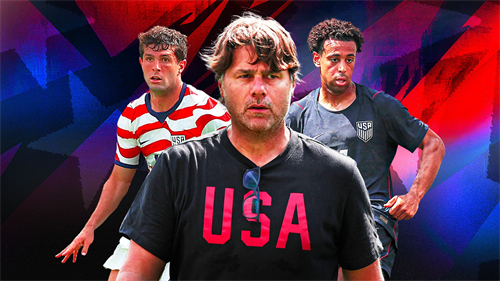
USMNT GFX
The U.S. responded well to going 1-0 down against Germany, but settled for little more than a hard-working loss against a better opponent - an eerily familiar outcome.
In the 48th minute of the USMNT’s fixture against Germany, Bayern Munich center back Jonathan basically allowed Christian Pulisic to shoot. The American scampered down the right. The pass into a streaking Folarin Balogun was on. Pulisic faked towards the middle and tried to take off to the outside. Tah stepped across, blocked the shot and looked remarkably relaxed doing so. What required maximum effort from the American looked laughably easy for the German.
And those are the levels.
It was a microcosm of this football match, all said, one in which the U.S. huffed, puffed and tried very hard. Germany still wanted to win, but for them, this was a more controlled affair. They got a goal off a set piece, and added another off a well-worked move. They never moved out of second gear.
The USMNT, meanwhile, were frantic and breathless. At times, it made for some pretty good football. The result? A 2-1 Germany win, and a remarkably comfortable one at that. They were, in effect, cruising.
There is plenty of rhetoric here from the American side about “fight” and “coming close.” But, ultimately, Germany were never truly pushed. The USMNT’s absolute best was a stroll for a World Cup favorite. And it’s hard to see where they go from here - which raises key questions about a big-money hire from U.S. soccer.
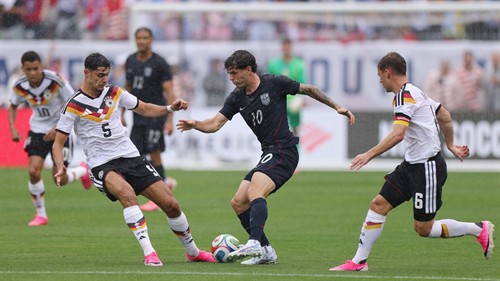
Christian Pulisic, USMNT
An improved performance
It is worth noting, first, that Saturday was certainly something of an improvement. The USMNT looked, for about 30 minutes, the best they have ever under Pochettino. The Argentine has spent the best part of his two years in charge shaking things up. This was close to a full-strength side, and the U.S. were not played off the park. A small victory? Sure. But one nonetheless. Indeed, it is, objectively, a good thing to go from “entirely outclassed” to merely “beaten.”
Yet the gap in quality was still clear. Germany scored inside two minutes, Kai Havertz nodding home from a free kick, a man who found himself remarkably open in the six-yard box. The Germans sort of fiddled with the ball from there. Florian Writz and Jamal Musiala provided attacking ideas. There was some nice movement from Havertz, and tidy passing from Joshua Kimmich. They had the ball in the net again after six minutes, only to see it ruled out after the ball was, correctly, adjudged to have gone beyond the touchline before a Leroy Sane cut back.
And then the USMNT fightback came. They didn’t control the game as much as shake it up. There was a bit more intensity about their press. Malik Tillman, a man who defended like there was a football match and attacked like there wasn't one, won the ball back here and there. Pulisic buzzed, bit, and dribbled. He looked lively, hungry even. Sergino Dest scampered down the right and darted into the box. Balogun chased plenty of lost causes.
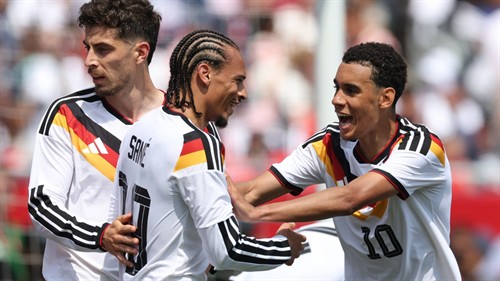
Germany USA
Germany stroll to a win
Germany, meanwhile, were never all that worried. The U.S. had just three touches inside their box after 25 minutes. Their first shot on target, in fact, was one that went in, Antonee Robinson - a player with just nine goals in his entire career heading into Saturday - volleying home from outside the box. He back-flipped in celebration like a man who had done it many, many times before.
There was a sense, though, that the U.S. were offering Germany a little too much - perhaps leaving themselves a fraction too open with their willingness to press.
And so it proved.
Just shy of the hour mark, Musiala found a bit too much space and whipped into the feet of Havertz - who also had too much space. Leroy Sane then wandered into - yep, you guessed it - too much space, and fired home. That was about it. Both managers rotated. Neither got much out of their reserves. The USMNT had a bit more of the ball, but did frighteningly little with it. Three of their four shots on target came in the second half. But they also failed to create a single “big chance.”
The lasting memory of the final 45 minutes, in fact, was a bit of skittish petulance. Tim Weah tackled a little too hard for David Raum’s liking. Nico Schlotterbeck responded with a shove. The U.S. bench emptied a touch performatively. The referee booked Weah and Schlotterbeck.
It is dangerous to analyze such moments. Objectively, they don’t mean that much. Certainly, from a USMNT point of view, it all looked a bit silly. The U.S. were getting beat. It was the 92nd minute. Weah did not need to go in two-footed - whether he won the ball or not. The bench clearing and getting a bit angry looked cool. But it’s hard to see what, exactly, it achieved.
After the game, Pochettino said the refereeing was questionable all game - but he liked the way his team responded.
“Germany was a little bit aggressive from the beginning, and I think the referee didn’t manage the situation well. And that was like creating the feeling that sometimes we need to be aggressive, too. The situation is good to have. They care, we care. We are competitive. They are competitive,” he said.
Yet, for most of their history, being competitive and showing a strong work rate has always been a part of the USMNT's DNA. For a program that has won one knockout game in its history, the expectation at this stage is more. And on the evidence here, it's difficult to see where that signature win is coming from. In fact, it raises questions about Pochettino in the first place.
The Argentine has an immaculate pedigree, having coached Tottenham, PSG and Chelsea, and was justly paid over $5 million for his first seven months in charge, according to tax documents. His predecessor, Gregg Berhalter, made a reported $1.6m per year. Only Carlo Ancelotti, who manages Brazil, makes more on the international level.
There have been some positive signs, but the U.S. and its fans have to stop accepting trying hard as a barometer of success.
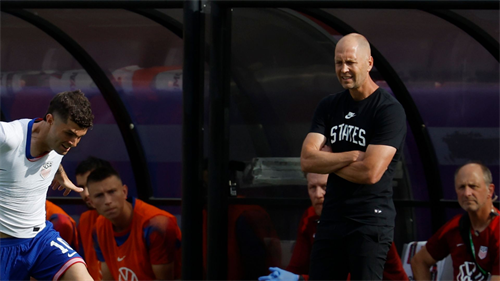
Gregg Berhalter USMNT 2023-24
Repeating the same glorious defeats
But it was also a charming sort of throwback. It was, in fact, the visualization of the vibe that the old generation had always tried to give off. They were, as they so often insist, outmatched scrappers. These guys were inferior on paper and therefore underrated, but they were gutsy enough to claw their way to wins - or, at least, triumphant defeats. It was, we are told, the U.S. way of doing things.
And that is mostly fine. This is a country without all that much of a soccer lineage. In a sense, you can only stick with what you know.
Their argument, though, lacks a bit of nuance. At some point "fight" has to lead to results. And thus far, there isn't much for the U.S., under Pochettino, to hang their hat on.
Perhaps the most encouraging part of Saturday’s loss was that there was something of a recovery. Going 1-0 down, in games past, has led to heavy defeats. Antonee Robinson made it clear after the game that he was happy with the U.S.’s response to conceding early. His argument? It was a good thing that the U.S. didn’t fall apart.
"Disappointed that we lost, but many positives to take," Robinson said. "I feel like conceding that early, we could have easily crumbled, and it could have been a very, very bad day to be going into the tournament with. But we fought back and at times played some really good football and looked good, looked competitive."
Tyler Adams echoed his sentiment.
"You don't envision the game in conceding in the first minute. When it happens, you have to rally together," Adams said after the game.
Opposing coach Julian Nagelsmann claimed, too, that it wasn’t the easiest game for his side. “I am keeping my fingers crossed,” the manager told American media.
Whether intended that way or not, he sounded faintly condescending.
“You have a good coach, who is a very nice person and a good coach, I’m hoping that it will be a good tournament for you...What they did that was difficult for us, they had a lot of good intensity; it is simply a team with a lot of speed in various positions.”
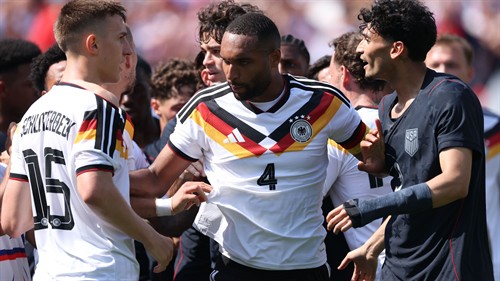
USMNT-Germany fight
What was promised
In September 2024, Pochettino weaved through his introductory press conference like a seasoned politician.
"We need to believe in big things," Pochettino said famously in his introductory press conference. "We need to believe that we can not just win one game, but the World Cup."
His first USMNT news conference was big on belief, big on ambition, and, unsurprisingly, big on personality. He repeatedly stressed that America should dream big, and that the USMNT should be inspired by the winning mentality and ambition seen across other American sports.
That, in his view, means a team that plays on the front foot: aggressive, attractive and unafraid of the moment. He also pushed back on the idea that there wasn't enough time before the 2026 World Cup, insisting that the players are talented and intelligent enough to adapt quickly. More than anything, though, Pochettino’s message was about mentality. After a bruising Copa America and a flat September window, the USMNT needed a jolt of confidence. Pochettino, loose, assured, and occasionally funny, seemed intent on providing exactly that.
"I don't see weakness [in the squad]," Pochettino said then. "We are always positive. We have very talented players."
Yet, since then, Americans are still waiting to see those promises materialize.
The manager, meanwhile, has defended his job.
“We are USA,” Pochettino said after back-to-back losses to Belgium and Portugal. “We are competing against Belgium, Portugal. I think for sure Belgium and Portugal have in the top 100 players, a few or some, players playing in that top 100. I think we don’t have. That is why it’s good to play against these types of teams.”
Right now, the question is whether the U.S. have truly gotten something meaningfully different from what they had before - beyond a bigger name and a much bigger salary.
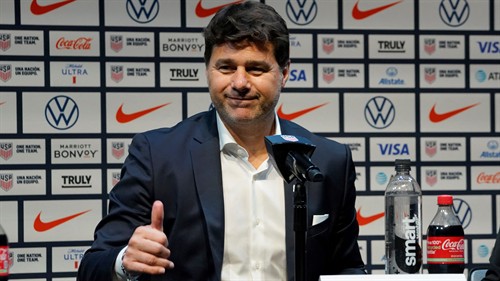
Mauricio Pochettino USMNT Press conference
Is it good enough?
More broadly, then, the U.S. should be feared. Pochettino shouldn't just be a "nice person and a good coach", who oversees a squad with "speed in various positions."
These guys should be both a top-tier footballing team and a nightmare to play against. Neither is really true. So, where, exactly, is the fear factor here? What does the U.S. actually do? If the best thing to be taken from a World Cup send-off game was that they didn’t crumble and they weren’t easy to play against, is that really worth celebrating?
This is an immensely expensive hire, with a glowing resume. The visible transformation, though, has been limited. Pochettino was brought in as a tactician who would also shake things up. To be sure, he is an elite coach, and he has dealt with major egos before, most notably with a star-heavy PSG side from 2021-22.
But it is unclear, as of yet, as to why the U.S. spent so much on one man. If the goal was to hit the reset button, make players fear for their spots, and build something, then what, really, has changed?
Berhalter routinely put on spirited sorts of performances against class opposition. Managers before him did mostly the same. Pochettino has adapted to the U.S., and admitted that he experienced a true culture shock.
But have the team really changed under him? At every juncture, in fact, they have simply lost “honorably” to a better team. Mexico, who picked a stronger side full of seasoned winners, were better in the Gold Cup final. Portugal and Belgium were better in March. Germany, too, are world class. The U.S. got a goal back, lost the game, and then lost their temper on Saturday.
Sure, ultimately, World Cups are about energy, vibe and spirit. The U.S. are, to be sure, counting on harnessing that. Tournament play is inherently unpredictable and silly in the best way possible. These are a group of guys who seem to like each other - and they deserve a sliver of credit for not giving up. And the post-game message seemed to be “that is good enough.”
But is it?
-
World Cup

- Daily
- Weekly
- Monthly



Your Say