"Public Enemy Number One": How Stefan Effenberg sabotaged his once-promising DFB career
Stefan Effenberg was once hailed as German football's greatest hope. Yet instead of converting his immense ability into a glittering career, he infamously flipped his middle finger to supporters and was shown the door by the DFB during a World Cup. Clashes with team-mates, an affair with a team-mate's wife, d
Posted Monday, June 08, 2026 by goal
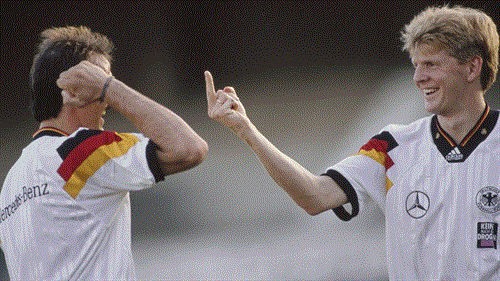
Stefan Effenberg
Stefan Effenberg was once hailed as German football's greatest hope. Yet instead of turning his considerable ability into a glittering career, he infamously flipped the bird to supporters and was shown the exit door by the DFB during the 1994 World Cup. Clashes with teammates, an affair with a teammate's wife, drink-driving convictions and an autobiography laden with erotic photos and spelling mistakes only reinforced his rebellious reputation. This is Part 14 of our Rebel United series.
Let's start where it all began. Stefan Effenberg's star rose during the 1997/98 season at Borussia Mönchengladbach, where newly installed head coach Wolf Werner spotted the talent of the then 18-year-old and promoted him to the first team. From the outset, it was clear that Effenberg defied the prevailing image of a German midfielder: unconventional, unfiltered, and unafraid to impose his will on the game through courage, aggression and natural authority.
By 20, he was already leading a Gladbach side that was a pale imitation of its 1970s heyday, yet he still shone. It soon became clear, however, that Effenberg answered only to his own rules. He did not care whether he was confronting a teammate or a referee—if something did not suit him, he would voice his displeasure. Or worse, he would lose his temper. Yellow cards, arguments and tensions followed him almost everywhere.
It took only three years for FC Bayern to take notice of Effenberg. The move to Munich seemed the ideal platform for him to launch the next phase of his journey toward global stardom, and for a time it was. He played brilliantly, scored goals, provided assists, and gradually became indispensable to the side.
Yet even at the German record champions, his antics continued. Effenberg refused to simply fit into a system, so he repeatedly clashed with coaches and teammates. The 1991/92 season was a prime example: Bayern endured a disastrous campaign, fighting relegation until the third-last matchday before finishing a disappointing tenth, and cycling through three coaches—Jupp Heynckes, Sören Lerby and Erich Ribbeck.
With several experienced leaders gone, the dressing room lacked clear hierarchy. Effenberg, now an international, pressed for a leadership role he was not yet ready to fill and quickly rubbed Heynckes up the wrong way. The dispute peaked when Effenberg allegedly roared, "Hey Heynckes, let's take this outside!" Soon after, the man who would later mastermind Bayern's treble departed, and Effenberg's first spell in Munich ended.
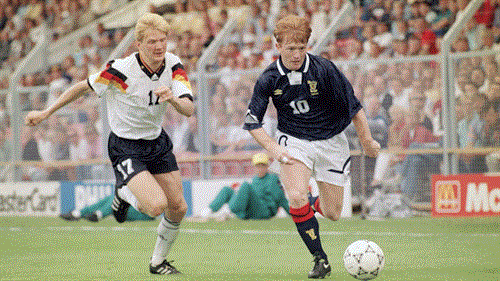
Stefan Effenberg
One moment during the 1994 World Cup shaped Effenberg's career
Two uneven years with Fiorentina—including both relegation and immediate promotion—culminated in a defining moment that would etch Effenberg into football folklore. Not a goal or a trophy, but a single gesture that turned him from a already polarising figure into "public enemy number one". At the 1994 World Cup in the USA, the 25-year-old Effenberg was at his peak: physically dominant, technically brilliant, and among Europe's best midfielders.
Yet the headlines were not made by his performances; instead, they focused on an incident that still haunts him. In the final group game against South Korea, Germany led 3-0 at half-time, yet the second half, played in Dallas's 48-degree heat, saw the advantage slip as the Koreans fought back. The Germans eventually hung on for a 3-2 win, but the travelling supporters were far from impressed by the defending champions' lacklustre display.
They made their feelings known with whistles, especially midway through the second half. When the exhausted Effenberg was substituted by national coach Berti Vogts in the 75th minute and replaced by Thomas Helmer, a veritable chorus of boos erupted. Instead of rising above the din, Effenberg—exhausted and irritated—turned toward the stands and extended his middle finger. He did not lower it while jogging toward the bench. Effenberg stood his ground, calm, deliberate and defiant, thrusting the provocative gesture into the faces of bewildered spectators.
Although no footage of the incident has ever surfaced, 'Effes' middle finger has become one of the most enduring images in German World Cup history.
The fallout was swift. The domestic press was ablaze with outrage, and the DFB was quick to impose disciplinary measures. That night, DFB President Egidius Braun and Vogts—already under fierce criticism—discussed the captain's fate. Ultimately, Effenberg was made an example of, a decision that players from that era still contest.
That 1994 squad was not a team; it was a collection of egos. The Bodo Illgner affair and the row over players' wives had already stirred things up, while the public rift between captain Matthäus and Vogts widened the divide. Franz Beckenbauer, on site as a Bild columnist, kept firing barbed comments at his successor. "Vogts was left in tatters," recalls the ARD documentary on the team's 1994 US failure.
As the tournament wore on, Vogts grappled with discipline and broken trust; in the end, Effenberg was made to pay the price. When he refused to issue a public apology, he was cut from the squad and sent home on the next flight. No suspension, no fine—just a humiliating one-way ticket home. Most players saw the punishment as wildly disproportionate to the "trifling matter" at hand, and Effenberg's expulsion deepened the rift between Vogts and the squad.
"Then they would have had to kick out at least four or five others as well," Mario Basler later told ARD, referring to the fateful middle-finger incident. In the end, the DFB side made a sensational exit from the tournament as reigning world champions in the quarter-final against Bulgaria. And Effenberg?
His international career was effectively over. The match against South Korea proved to be his last competitive outing for the DFB. Apart from two friendly matches in September 1998 against Malta and Romania, when he was allowed to pull on the German jersey once more for 180 minutes—under Vogts's command, no less—Effenberg's DFB career was over. Not because of injury, not because of a lack of form, but because he couldn't control himself for two seconds.
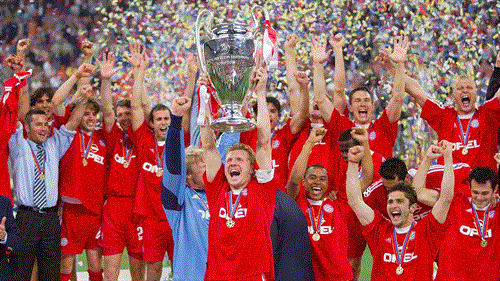
Stefan Effenberg
At FC Bayern, Effenberg emerges as the "boss" under Ottmar Hitzfeld.
Even after his suspension, Effenberg offered no apology. Far from showing remorse, he embarked on a string of fresh scandals that grew both more frequent and more serious. After a second, three-year spell at Borussia Mönchengladbach—arguably the calmest and most consistent phase of his career—Bayern Munich came calling again. The offer was too good to refuse, despite his mixed first stint in Munich.
From a sporting perspective, the move paid off handsomely. Effenberg, the team's undisputed leader and linchpin, guided Bayern to three consecutive Bundesliga titles from 1999 to 2001 and to the long-awaited Champions League triumph in 2001, capping an epic penalty shootout against Valencia. He then stepped up to convert the equaliser from the spot after Mehmet Scholl had earlier missed.
Despite his combative personality, he was manager Ottmar Hitzfeld's first choice—the man tasked with turning the so-called "FC Hollywood" into a cohesive unit. The Swiss coach installed the once-ridiculed midfielder as his on-pitch lieutenant, cementing his status as the club's uncontested "boss". Even a drink-driving offence in October 1998, with a blood-alcohol level of 1.1 per mille, only temporarily strained their relationship; the club fined him heavily but Hitzfeld stood firm.
Yet even at the peak of his powers, the next controversy was never far away. His most famous feud was with Lothar Matthäus, a Ballon d'Or winner and World Cup champion who was an internationally recognised legend—but Effenberg simply did not care. The pair repeatedly traded barbs in the media, forcing teammates to choose sides. Matthäus had his camp; Effenberg had his.
Off the pitch, his affair with teammate Thomas Strunz's wife Claudia made front-page news and threatened to split the Bayern dressing room. Undettered, Effenberg married Claudia in December 2004 after divorcing his own wife, Martina.
His legendary run-ins with the ever-critical Munich media were almost entertaining: Effenberg often spoke of himself in the third person ("You can't break a Stefan Effenberg") and bluntly told reporters what he thought of their constant criticism.
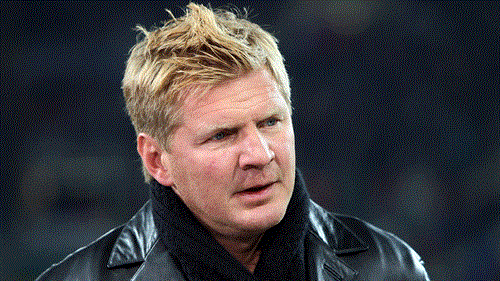
Stefan Effenberg
In his autobiography, Effenberg settles scores with his former teammates.
Even after retiring in 2004, following a disappointing spell at VfL Wolfsburg, Effenberg stayed in the spotlight. A quiet exit was never likely, so in his 2003 autobiography, *I Showed Them All*, he fired broadside after broadside at former managers, teammates, the media and even fans.
The tone was vulgar and deeply personal. He once again took aim at Matthäus, justified every controversial moment of his career and apologised for nothing—not the middle finger, not the affair, not the scandals. As if that were not enough, the book also contained erotic photos of him and Claudia, plus a host of spelling errors that soon had the media ridiculing him.
Love him or loathe him, Effenberg was a colourful character in German football. He thrived on provocation, and that trait—for better or worse—is what made his career so memorable. He had the talent to be a national icon, yet he always played by his own rules.

- Daily
- Weekly
- Monthly


Your Say