Winning at all costs: How Inter under Suning are chasing glory with unsustainable billions
How Chinese owners Suning turned Inter into Serie A champions and Champions League finalists with massive spending — only for mounting debts, COVID losses, and failed sponsorships to hand the club to Oaktree. A must-read financial autopsy of winning without sustainability.
Posted Wednesday, May 13, 2026 by goal
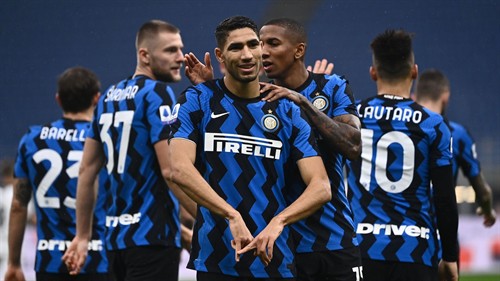
Achraf Hakimi Inter 2020
How Chinese owners Suning turned Inter into Serie A champions and Champions League finalists with massive spending — only for mounting debts, COVID losses, and failed sponsorships to hand the club to Oaktree. A must-read financial autopsy of winning without sustainability.
On 22 May 2024, ownership of Internazionale Milano passed to Oaktree Capital Management. With this, Inter Milan followed in the footsteps of its city rival A.C. Milan. While one might first think of on-field successes, the more telling overlap was off the pitch, in the boardroom. In 2019 AC Milan had been taken over, and in the meantime successfully turned around, by Elliott Management. Now Inter found itself at the onset of this turnaround.
There was no auction, no press conference, no white-knight bid. There was simply a loan that had matured and could not be repaid. Suning, Inter’s Chinese owners that had acquired 68.55% of Inter Milan's shares from Moratti and Tohir at a price of €270m euros in 2016, had borrowed €275m from Oaktree three years earlier at 12% interest. By 2024, the balance owed had grown to €395m.
Suning could not pay, a credit event followed.
It left the club in the hands of Oaktree, an American credit fund with at that time, over $192bn assets under management (AUM), that now suddenly found itself in control of a premier European football asset.*
*Oaktree inherited 99.6% of the shares of Inter, also acquiring the 31.0% shares from minority investor LionRock through a receiver sale.
The case of Inter Milan presents how consistent and unsustainable debt funding of on-field performance ultimately results in creditor ownership. Both Oaktree's takeover and Elliott's earlier move at AC Milan provide a case study in the intriguing and compelling value creation potential of distressed assets in the football industry.
Within the third edition of the Milan miniseries we’ll explore the road leading up to Inter’s takeover as well as Oaktree’s actions afterwards.
By the time Suning acquired a majority stake in Inter in June 2016, the club had already endured years of both financial and sporting decline. Between 1995 and 2013, Inter was controlled by the Moratti family, a period defined by significant shareholder funding with at its peak the historic 2009/10 treble under José Mourinho. Yet the success came at a substantial financial cost, with recurring operating losses consistently underwritten by family capital.
Following a sequence of disappointing league finishes and growing financial pressure, Indonesian businessman Erick Thohir acquired control of the club in 2013, reportedly purchasing a 70% stake for approximately €250m, implying a total valuation of around €350m. At the time, Forbes ranked Inter as the fourteenth most valuable football club globally. Thohir’s arrival was initially welcomed by supporters, particularly as the Moratti era appeared increasingly unsustainable both financially and competitively.
Thohir’s tenure marked the beginning of Inter’s transition from a traditional family-run institution into a more commercially oriented football business. Financial restructuring, management professionalisation, and international commercial expansion, particularly across Asian markets, became central priorities. Reports at the time indicated that Thohir also refinanced or restructured roughly €180m of club debt. While governance structures became more corporate under his leadership, sporting results remained inconsistent, with Inter finishing 5th, 8th, and 4th during his three seasons in charge under Walter Mazzarri and later Roberto Mancini.
Ultimately, Thohir laid important organisational and financial groundwork for future ownership, but the broader structural weaknesses remained unresolved. Inter's commercial profile lagged Europe's elite, and the gap to Juventus domestically was equally wide. Core revenue (excl. player trading) in 2015/16 stood at roughly €180m, less than half of the €388m Juventus generated. The club lacked Champions League income, stadium ownership, and meaningful commercial momentum. What Inter still possessed, however, was a globally recognisable brand whose stature exceeded the strength of its balance sheet.
To remain competitive despite these limitations, Inter increasingly turned toward financial engineering. In 2014, the club created Inter Media & Communication, a special purpose vehicle (SPV) designed to hold the club’s media rights, sponsorship revenues, historical archive, and intellectual property. Inter subsequently transferred the club’s brand into the SPV for approximately €139m, booking a significant one-off accounting gain that transformed a heavy operating loss into a statutory profit of roughly €33m.
More importantly, the SPV later became the collateral foundation for Inter’s bond programme, a structure that would fundamentally reshape the club’s financial architecture in the years ahead. In many ways, the transaction reflected a broader pattern that would continue under subsequent ownership: monetising future revenue streams to solve present financial constraints. The 2014 restructuring was the prototype. The later bond issuances became the scaled version.
By the time Suning arrived, Inter was already a club dependent on recurring shareholder support, accounting optimisation, and future revenue securitisation. The leverage intensified later. The structural dependence had already begun.
The Thohir era formally came to an end on 6 June 2016, when Zhang Jindong’s Suning Holdings acquired a 68.6% controlling stake in Inter for approximately €270m, implying an equity valuation of around €390m. Eight years later, when Suning lost control of the club, that same stake had reportedly been written down to just €148m on its own books. Between those two valuations sits the defining contradiction of the Suning era: hundreds of millions of euros of investment, renewed sporting success, a return to the summit of Italian football, and eventually a Champions League final, but also a financial structure that became increasingly fragile and unsustainable.
Suning’s strategy was evident from the outset: restore Inter to domestic and European prominence through aggressive squad investment. It followed the dominant logic of modern football economics: the clubs that spend the most generally maximise their probability of winning. On the pitch, the approach initially worked. Antonio Conte arrived in 2019, finished second in his first season, and delivered Inter’s first Scudetto since the Mourinho era in 2020/21. The title-winning squad was assembled rapidly and expensively, with players such as Romelu Lukaku, Achraf Hakimi, Christian Eriksen and Arturo Vidal symbolising a model built around immediate competitiveness rather than gradual financial consolidation.
A quick look at the financial trajectory illustrates the imbalance. Between 2016 and 2021, Inter’s revenue increased from approximately €241m to €354m, a rise of roughly 51%. Over that same period, however, wages increased by more than 110%, from €124m to €262m. The club’s squad cost ratio became increasingly problematic. On a reported basis, squad costs as a percentage of revenue reached levels of 91.4%, 103.9%, and 95.4% between 2020 and 2022, far above UEFA’s recommended 70% sustainability threshold.*
*Calculated on the basis of UEFA’s ratio, using average net transfer profit in L3Y, with 2019 and 2020 figures altered due to missing data.

- Daily
- Weekly
- Monthly
Photos
More»

Hot pics of stunning Danielle Renae
Friday July 24 2026
Why the 2026 World Cup was greatest ever
Friday July 24 2026
Your Say