Jean-Marc Bosman made every professional footballer richer. Yet he remains a poor man himself
The Bosman ruling revolutionised football in 1995. It shifted the balance of power in favour of the players and accelerated the professionalisation of the sport. Yet few remember the player behind the ruling. Part 13 of our Rebel United series.
Posted Monday, May 11, 2026 by goal
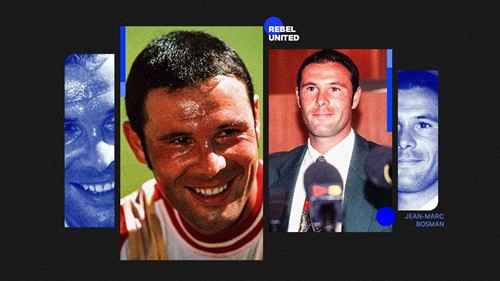
Jean-Marc Bosman Rebel United
The Bosman ruling revolutionised football in 1995. It shifted the balance of power in favour of the players and accelerated the sport's professionalisation. Yet few recall the player whose case triggered this landmark decision. Part 13 of our Rebel United series.
The man who inadvertently enriched practically every professional footballer—and their agents—had no intention of reshaping the sport. Jean-Marc Bosman did not set out to be a rebel; he did not plan to drag his club, RFC Liège, the Belgian Football Association and, ultimately, UEFA, to the European Court of Justice.
Bosman did not set out to "give football something wonderful," as he puts it today, nor did he expect to pay the ultimate price himself. "I had a chaotic life," he says, describing a downward spiral marked by alcohol, debt, depression, a domestic-violence charge and chronic hardship. He revolutionised the sport, yet the game soon cast him aside. "It's sad, but from the very beginning they wanted to wipe me out. I was ignored. But I realised that you pay a price when you challenge an established power structure," he says today.
He simply wanted justice for himself—the right to move to French second-division side USL Dunkerque after his contract with Belgian first-division club RFC Liège expired in the summer of 1990.
Bosman, a 25-year-old average attacking midfielder, had risen through Standard Liège's youth system and made his professional debut there, yet he had managed only 25 Division 1 appearances for local rivals RFC over the previous two seasons. He was relieved that his RFC contract was expiring; the last few months had been turbulent. He had fallen out with the manager and the board; the club had offered him a new deal but at only around 850 euros per month—a quarter of his previous salary. This was 1990: 850 euros for a top-flight player in Western Europe? In 1990, that was derisory; a Belgian factory worker earned about 1,000 euros a month. So when second-tier French club Dunkirk came calling, it looked like a lifeline: a bigger footballing environment just across the border. The deal seemed sensible for a player of Bosman's profile.
The only problem was that RFC Liège refused to release their number 10 without a fight, demanding a transfer fee of between 600,000 and 800,000 euros—for a player whose contract had expired and who had just been offered the Belgian minimum wage.
Dunkirk were unwilling or unable to meet the fee, and Liège blocked the transfer. So Bosman went rogue: he surrendered his professional status, re-registered as an amateur, and walked out of Liège. To stay match-fit, he first joined a French fifth-tier club and, a year later, moved to a top-flight outfit on the French island of La Réunion in the Indian Ocean. Most crucially, he sued his former club and the Belgian Football Association for damages.
On the pitch, his moves backfired: he found life on Réunion unpleasant, and upon returning to Belgium in 1992 he could not secure a new contract. His application for unemployment benefit was rejected, and for several years he lived in the garage of his parents' home.

- Daily
- Weekly
- Monthly
Photos
More»

Meet stunning Onlyfans model Skyler Simpson
Thursday June 18 2026
[PICTURE SPECIAL] England 4-2 Croatia
Thursday June 18 2026
Your Say